


Review: Pulsar Labs Open Source Function Generator DIY Kit
The Sweep mode is perfectly usable for most applications, such as as an amplitude curve. By default it is sewt for a sweep from 20 Hz to 20 kHz and 100 steps per decade (the display then shows ‘Sweeping…’). To be clear, the frequency jumps from the highest value back to the lowest value and the sweep then repeats. During the sweep the waveform cannot be changed. For this you first need to stop the sweep by pushing the rotary encoder.
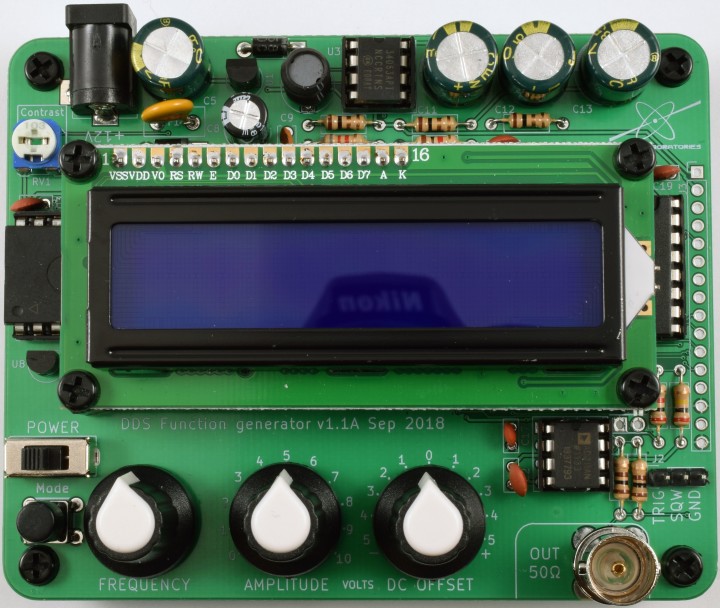
Maximum/minimum amplitude for all three waveforms is about +10 V/-10 V (no load, offset maximum, amplitude maximum, clipping).
Conclusion
This function generator kit can be assembled without too much effort. This should be able to be done in less than 3 hours. Mistakes are mainly avoided by working meticulously. The operation is extremely user-friendly. Only for operating the sweep mode it is certainly advisable to grab the manual. The rest is basically self-explanatory. Amplitude and offset are set using potentiometers and for precision applications another measuring instrument will have to be used, such as an oscilloscope or multimeter. The control via RS232 is very limited, but nevertheless offers the option for use in other applications, for example in automated measurements. That will also be the reason that no nice enclosure or mains adapter is included. But for this price you will have a very nice function generator in your hands.Specifications
| Power supply | +12 V |
| Current consumption, no load | 110 mA (amplitude min., offset max. positive) |
| 125 mA (amplitude max., offset max. negative) | |
| Offset range | -5.7 V / +5.3 V (amplitude min.) |
| Output voltage sine | 0...3.7 V |
| Distortion sine minimum | 0.1 % (0.7 V, no load, 1 kHz B = 22 kHz) |
| Distortion max. signal | 0.4 % (3.7 V) |
| Amplitude square wave | 0...10 Vpp |
| Amplitude square wave on J2 | 0...5 Vpp (only present in square wave mode, minimum is always 0 V) |
| Rise time | < 20 ns (loaded with 50 cm coax and 1 MΩ / 15 pF) |
| Amplitude triangle | 0...10.4 Vpp |
Maximum/minimum amplitude for all three waveforms is about +10 V/-10 V (no load, offset maximum, amplitude maximum, clipping).
Read full article
Hide full article
Discussion (0 comments)