


Embedded Communication Connector (ECC)
(Extension) connector specifications are very useful to establish a system of controller-boards and peripheral boards which can be combined flexibly. Different companies can work together in developing appropriate boards and modules and end-users can even develop their own electronics which fits to the connector.
(Extension) connector specifications are very useful to establish a system of controller-boards and peripheral boards which can be combined flexibly. Different companies can work together in developing appropriate boards and modules and end-users can even develop their own electronics which fits to the connector.
The Elektor-Linux-Board has a 14-pin-extension-connector with SPI/I2C/ADC/PWM/GPIO-pins, a lot of extension boards can be connected here; the Elektor Xmega-Webserver-Board (September 2013) has the same connector integrated (EEC = Embedded Extension Connector).
What we additionally need is a connector for UART/TTL=RXD/TXD and some additional, supporting GPIO-pins. This connector should also have (like the EEC) a supply-voltage-pin, so a peripheral board can be supplied by the controller-board. For example, you can have a RS485-extension-board (with RS485-driver-IC and screwclamps) to be connected to a controller-board. A RS232-module with a MAX232 could be another option for a peripheral board.
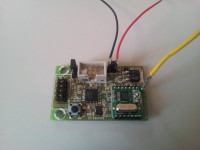
However, the thing is more complicated in this case, because we also have to think about the possibility to connect two different controller-boards. The Elektor Lab is currently working on a 433-MHz-Board, equipped with a 433-MHz-Transceiver-Module and an ATmega-controller. This board will have an RX/TX-connector to be connected with a bigger (base-)controller-board, it acts as a gateway between „433-Mhz-wireless-transmission“ and „UART/TTL“. There are also WLAN-to-UART- and Bluetooth-to-UART-modules which are used in a similar way.
It would be nice if we could connect those gateway-modules
1. to bigger controller-boards, supplied by these boards
2. directly to a peripheral module like RS485 or RS232 to form a lightweight 433MHz//WLAN//Bluetooth <-> RS485//RS232-Gateway
After some brainstorming, we found that this could be possible with one and the same connector when we use a pinout like this:
Controller-Board
GPIO VOUT
GND GPIO
RX TX
GPIO GND
NC GPIO
Peripheral Module
GPIO VIN
GND GPIO
RX TX
GPIO GND
NC GPIO
Gateway-Module
GPIO VOUT
GND GPIO
RX TX
GPIO GND
VIN GPIO
You can see that the gateway can act like a controller-board to be connected to a peripheral module and to supply the peripheral module. Additionally, the gateway can be connected to a controller-board when you rotate the cable-connector by 180°:
GPIO VIN
GND GPIO
TX RX
GPIO GND
VOUT GPIO
The gateway-module can now be connected to a base-controller-board (RX and TX are swapped) and can be supplied by the voltage of this board (VIN connected to VOUT of the controller-board). On the gateway-module, there must be a jumper to select the supply-voltage via the connector (VIN) or additional extern power supply.
Additions:
1. We first want to begin with a 5-V-version of the connector.
2. Always use male pin-headers as connectors on the boards and modules to be connected by usual flatcables.
Current Status:
RS232-module (planned):
CTS VCC
GND NC
RX TX
NC GND
NC RTS
RS485-module (in lab-phase)
DE VCC
GND NC
RX TX
NC GND
NC /RE
433-MHz-Gateway- Module: in lab-phase
Bluetooth-Gateway-Module BTM-222 (planned)
WizFi-WLAN-Gateway-Module (planned)
Want to build a project?
Bring your design to life with the Elektor PCB Service, powered by Eurocircuits. Upload the project files and order professionally manufactured PCBs or assembled boards through a proven European production platform.
Supporting KiCad, Eagle, Gerber, and ODB++ formats, the service is suitable for everything from prototypes and validation builds to series production and volume manufacturing.
Made in Europe. Fast. Reliable. Professional.
Discussion (1 comment)