Main features:
- Circuit to activate an Opamp
- PCB is shielded, thus suitable for sensitive tests.
- Can test single or dual opamps.
- Easy modification for high speed/wideband applications.
Concept
This project emerged from the desire to quickly verify the THD (Total Harmonic Distortion) of an op-amp. For this I have a distortion analyzer available, but it needs an application board to activate the opamp. Since THD or THD+N (THD + Noise) are sensitive tests, I like to have the board in a good metal case.
Design
The testcircuit is a non inverting amplifier circuit with gain of 10x. The difference with a inverting amplifier circuit is, that the positive input is not grounded but swings with input voltage, thus inherent more critical. The gain of 10 is suitable to match input and output specifications of my audio analyzer. One can modify the resistor values, if one opts for a different gain. But this 10 times gain is well suited to test an opamp, to give it some output-swing.
If one is more interested in wideband operation, the resistor values can be lowered, for example divide their values by a factor 5 or 10.
For the practical implementation it was chosen to put IC sockets on one side of the PCB, and the other components on the other side. All SMD components in case the circuit is used for high-speed or wideband testing.
On one side the test sockets
On the opposite side the components and wire connections
Implementation
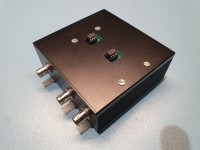
A metal box with dimensions: 40x110x100mm was chosen. The circuit was implemented for two IC sockets of DIL-8. One for single and the other for dual-opamps. For SMD-opamps an adaptor socket can be used, but one might lose some performance. All signal connections are with coax and BNC connectors.
Here is the test box in full action, verifying THD of a Dual opamp
Want to build a project?
Bring your design to life with the Elektor PCB Service, powered by Eurocircuits. Upload the project files and order professionally manufactured PCBs or assembled boards through a proven European production platform.
Supporting KiCad, Eagle, Gerber, and ODB++ formats, the service is suitable for everything from prototypes and validation builds to series production and volume manufacturing.





Discussion (0 comments)