


Review: JOY-iT Joy-View Portable Touchscreen
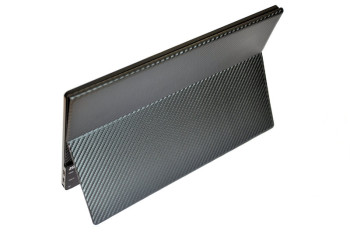
to act as a stand for the monitor.
First I connected the screen to my desktop PC running Windows 10. This worked perfectly with the HDMI cable, with power being supplied by the included AC mains adapter. In this case I did not connect the touchscreen, because it would be a bit confusing in a setup where the desktop is divided over two screens and only one of them is touch sensitive.
The next combination was the Joy-View 13 with my Windows 8 laptop. That worked very well. After connecting the HDMI cable and the USB‑C cable to the USB‑3 port of my laptop, I immediately had video with touchscreen functionality. This worked very nicely – the screen responded directly to touch input, and Windows 8 (just like Windows 10) is well prepared for touchscreen use.
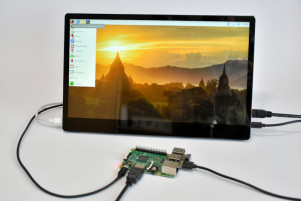
The final combination was a Raspberry Pi 3B running a current version of Raspbian. Here as well, the RPi was connected to the Joy-View 13 through two cables. With this arrangement, the touchscreen also worked right away, with no need to adjust any settings in Raspbian. However, I had some problems with supplying power to the screen. With a reduced resolution setting, the RPi was just able to supply enough current to the monitor through the USB port, but with full resolution things went wrong and I had to connect the AC mains adapter. Aside from that, everything worked well.
I also tried to connect the screen to a fairly recent tablet with a USB‑C connector, but unfortunately this did not work. However, the laptop model was not in the Joy-iT list of compatible devices.
Conclusion
The Joy-View 13 portable touchscreen monitor is a nicely finished unit that provides excellent video and can be used in many applications and with many different devices thanks to the built-in capacitive touchscreen, the versatile connection options and the variety of power supply options. If you are looking for a monitor that is compact and easily portable, the Joy-View 13 is an excellent choice. And if you would like to have something a bit larger, you can also opt for the 15.6-inch version of this monitor, the Joy-View 15.Read full article
Hide full article
Discussion (0 comments)