


Universal AC to AC convertor with PFC
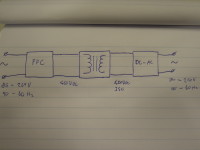
This is a concept for an AC powered, isolated AC generator with a PFC in front.The aim is for a 750VA to 1000VA output. The concept is for a multipurpose device. You could use it to connect mains polluting devices that use Thyristor dimmers or peak rectifiers.
This is a concept for an AC powered, isolated AC generator with a PFC in front.
The aim is for a 750VA to 1000VA output. The concept is for a multipurpose device. You could use it to connect mains polluting devices that use Thyristor dimmers or peak rectifiers. You could use it to connect devices which are meant for a different voltage and frequency than is availible on your wall outlet. Or for instance really old electronics which could fry when the mains voltage is 10V to high. And ofcourse whatever you can think of. I was thinking of a modular design so the PFC, isolator and DC-AC have seperate PCBs
PFC
Almost all modern high powered, mains connected devices have a power factor correction circuit. There are lots of dedicated controllers on the market which can do this. Functionally it looks like a really complex boost/step-up convertor which shapes the load.
Isolator DC-DC
A fullbridge design would allow for an efficient design. Though getting a suitible transformer could be a bit of a challenge. It has to be high frequency, high energy and it has to have a high isolation value. I wonder if that is even possible. As for a controller, something like a LTC3722 could be used.
DC-AC
Because of the high DC input voltage it will probably look a lot like the end stage of a class-D amplifier. There has to be a feedback loop to ensure a good waveform regardless of the attached load. Also a reference sinewave has to be generated, probably by a DDS so the frequency can be accurately controlled. A multiplying DAC could be used to scale either the reference sinewave or the output feedback, so the output amplitude can be changed.
Want to build a project?
Bring your design to life with the Elektor PCB Service, powered by Eurocircuits. Upload the project files and order professionally manufactured PCBs or assembled boards through a proven European production platform.
Supporting KiCad, Eagle, Gerber, and ODB++ formats, the service is suitable for everything from prototypes and validation builds to series production and volume manufacturing.
Made in Europe. Fast. Reliable. Professional.
Discussion (2 comments)