


€5 (FREE for Members)
Audio A/B Selector With Gain Control: Switches from Microphone to Line Inputs
October 27, 2025
on
on
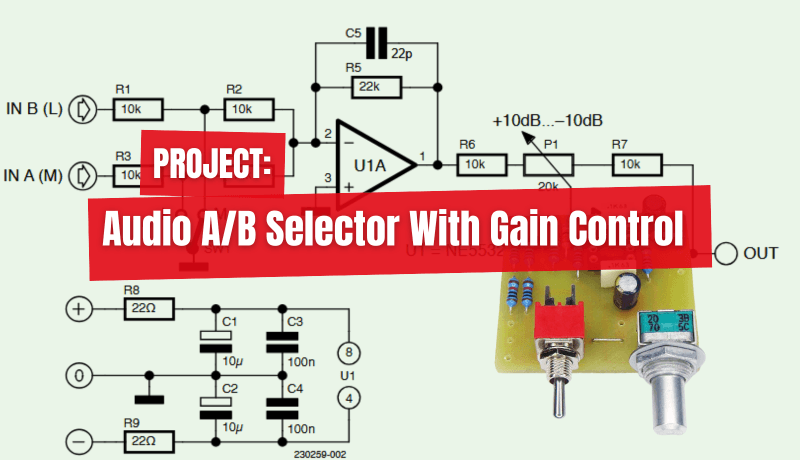
In audio circuits, the innovative technique of virtual grounds provides a viable alternative to the traditional method of switching signal lines. In this approach, signals don’t pass through the switch; instead, the ground serves as the “mute/unmute” control. This project features clever circuitry using op-amps and resistors to seamlessly switch between microphone and line inputs, with a built-in gain compensator for maximum control.
First, let me say that this project is complementary to two other publications of mine: “Microphone Preamplifier with Phantom Power" and “Balanced to Unbalanced Converter." Both were also featured in previous Elektor Circuit Specials. You can find more on that in the article “Jack In & Jack Out” later in this edition.
This project serves as Mic/Line switch using the technique of virtual masses. The advantage is that the signal does not pass through the switch; it is the ground that makes the function “Mute/De-Mute.” Here is how it works.
First, let me say that this project is complementary to two other publications of mine: “Microphone Preamplifier with Phantom Power" and “Balanced to Unbalanced Converter." Both were also featured in previous Elektor Circuit Specials. You can find more on that in the article “Jack In & Jack Out” later in this edition.
This project serves as Mic/Line switch using the technique of virtual masses. The advantage is that the signal does not pass through the switch; it is the ground that makes the function “Mute/De-Mute.” Here is how it works.