All year, we have been celebrating Elektor's 60th anniversary. This month, we take a look at some of the editorial team's favorite articles from past December editions of Elektor magazine.
All year, we have been celebrating Elektor's 60th anniversary. This month, we take a look at some of the editorial team's favorite engineering articles and DIY projects from past December editions of Elektor magazine. Take a look.
Christmas Candle (December 2020)
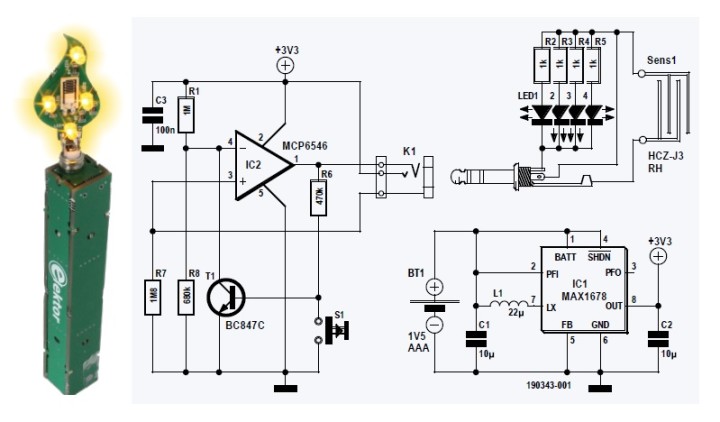
Last year, Elektor Lab engineers Clemens Valens and Luc Lemmens took two old Elektor projects and combined them into a fun new Christmas candle design. "The candle and its enclosure consist of eight smaller circuit boards, for production joined in one PCB panel," Valens and Lemmens explained in article about the €20 project. "There are silver-colored openings in the green solder mask at several edges and corners of the boards. These are areas that are used to join the boards by soldering. Some of the joints are only necessary to keep the boards together, others also important to interconnect the circuits on the PCBs." Users can "blow out"t he candle because the engineers incorporated an HCZ-J3 (Multicomp) humidity sensor that can detect breath. Learn more about the project.
Christmas candle project (2020)
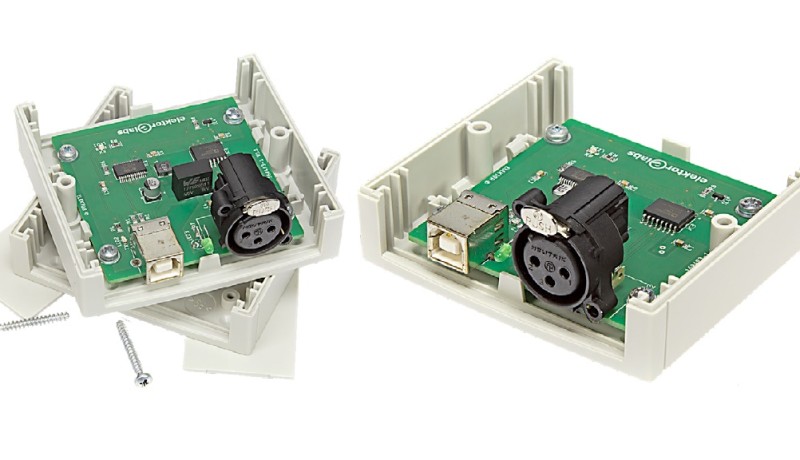
Compact USB-to-DMX Converter (December 2018)
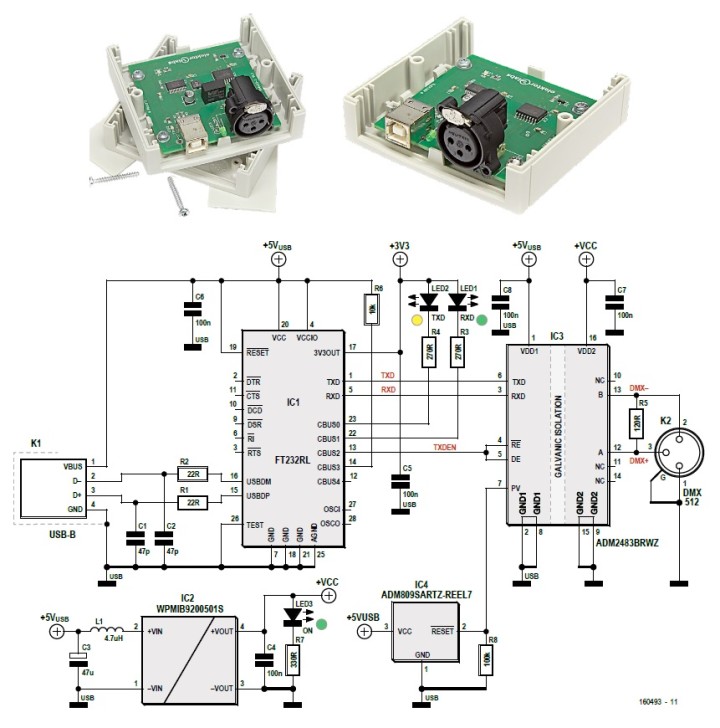
Properly isolated USB-to-DMX512 converters tend to be very expensive. In this article, an Elektor Lab staffer describes a DIY alternative, which is more affordable than equally specified isolated converters. The converter comprises four ICs of which two, DC/DC converter IC2 and RS-485 transceiver IC3, are responsible for complete electrical isolation between the DMX lighting gear on the one side and your laptop on the other. Specs:
Full AC line isolation between DMX gear and laptop
USB to DMX Converter with full electrical isolation (December 2017)
"Due attention was given to all aspects of electrical isolation, i.e. the USP (unique selling point) of this converter," the author explains. "All PCB tracks responsible (so to speak) for the electrical isolation are spaced at distances affording or exceeding the required degree of safety. The circuit board was specifically shaped to fit in a Bopla type 26085000ABS housing." Read more
USB Data Logger: Store Serial Data Conveniently, Safely (December 2011)
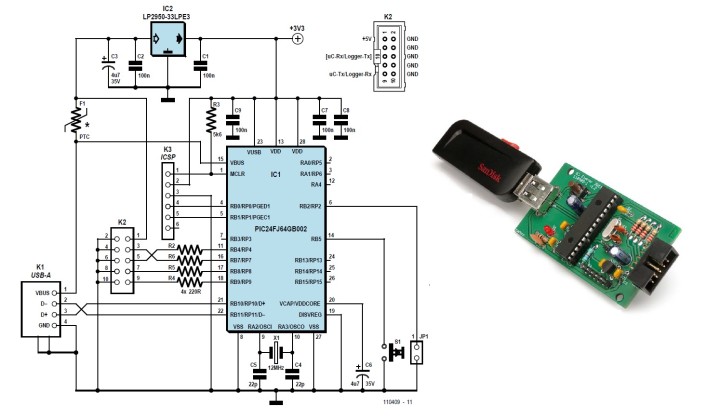
In 2011, Elektor presented an interesting design that enabled engineers to use a standard USB memory stick to store data in a microcontroller-based system. As explained in the article, memory sticks offer users a large volume of portable, non-volatile memory space. For this USB data logger application, the memory stick plugs into the data logger system, which acts as a host USB controller that can log or store serial data sent to it. A Microchip Technology PIC24FJ64GB002 microcontroller handles these tasks.
The USB serial data logger circuit basically consists of a microcontroller functioning as a USB host. (December 2011)
"The data logger will be in recording mode when it is powered up and a memory stick is fitted," the author Thomas Fischl explained. "Short flashes from the LED indicate that data is being received over the serial interface. Received data is stored 1:1 in the ‘logging.txt’ file. Before unplugging the memory stick it is necessary to press the store pushbutton; this ensures that all data held in the receive buffer is stored to the logging file and that the file is closed cleanly. The stored data can then be read on any PC by plugging the memory stick in to a free USB socket and reading the contents of the ‘logging.txt’ file using a simple text editor program."
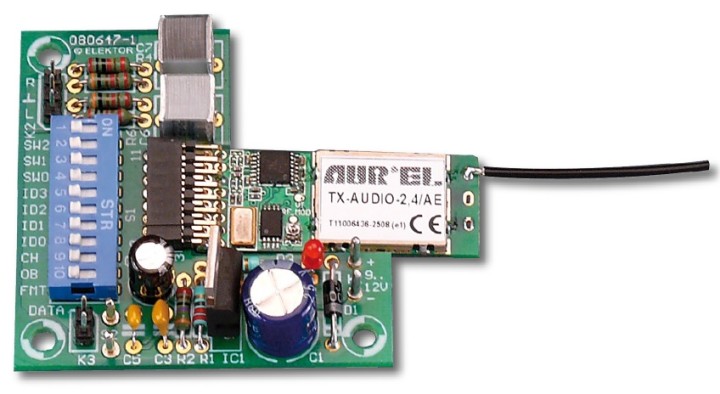
Hi-Fi Wireless Headset: 2.4 GHz Digital Audio Link (December 2008)
Today, most of us have wireless headsets. But that wasn't the case back in the mid-2000s, which is why a forward-thinking Elektor reader built his own hi-fi wireless headset. The headset featured a transmitter designed to be connected to any audio or video source (e.g., TV or stereo) and a receiver to which you can connect any headphones you like.
Hi-Fi wireless headset (December 2008)
"We can tell you right away that our headset offers distortion as low as 0.016% at 1 kHz and a signal-to-noise ratio of 75 dB," Christian Tavernier explained. "These are figures actually measured on the Elektor prototype between the transmitter input and the receiver headphone output socket, i.e. including the radio link; the connoisseurs will appreciate this!"
The sound level that can be achieved from the headphone output using the OPA 2134 is more than adequate, whether you use a medium- or low-impedance headset. The frequency response, measured under the same conditions as the distortion, is from 15 Hz to 18.5 kHz at the -3 dB points.
Novel Liquid-Level Sensor (December 2001)
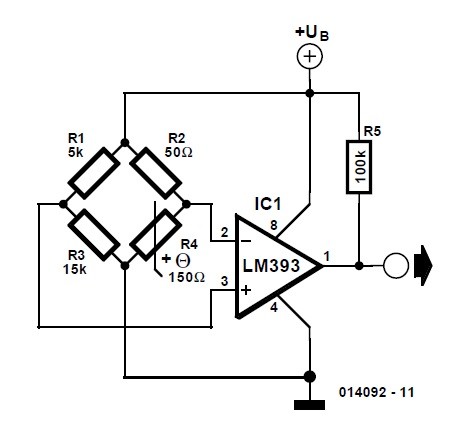
Need to determine the level of a liquid in a container? You can do so by sensing changes in the capacitance or resistance between a pair of immersed electrodes, but that approach can require complicated circuitry to protect against electrolysis (and corrosion). This December 2001 article presents an alternative.
Liquid level sensor circuit (December 2001)
"Here we utilise the fact that a PTC resistor warms up in proportion to the amount of current flowing through it, with the result that its resistance increases," Elektor published. "If a PTC resistor is immersed in a liquid, the additional warmth is dissipated in the liquid and the resistance remains nearly constant. If the level of the liquid drops below the immersion depth of the resistor, the change in the resistance can be easily sensed by a subsequent comparator stage."
Smart Transistor Tester (December 1995)
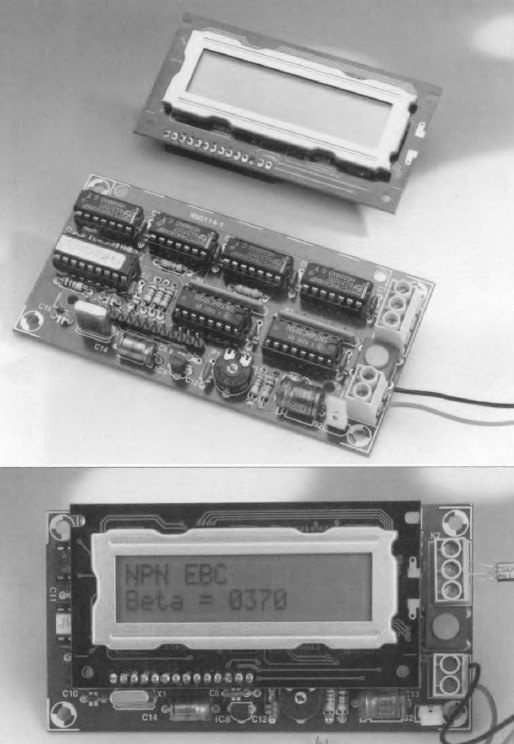
Back in 1995, Elektor explained that, when using a transistor tester, it is important to ensure that the transistor is properly inserted in the test socket. The tester in this article features a microprocessor that determines the transistor type (n-p-n or p-n-p), ascertains the pinout, measures the current amplification, and then presents the results on an LCD.
Smart transistor tester (December 1995)
"In the destgn of the tester, which is suitable for use with bipolar tranststors only, it was, therefore. decided to provtde not only type detection (n-p-n or p-n-p) and determination of the current amplification factor, but also automatic pinout identification. Other aspects were ease of operation and clear display of the test findings. These requirements are comfortably met by the use of a microcontroller."
Logic Tester (December 1990)
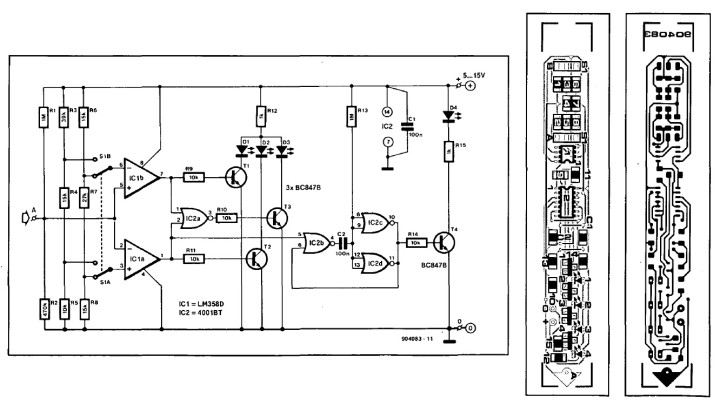
Elektor has published several logic tester designs during the past 60 years. Consider the following compact DIY design presented in December 1990.
Logic tester (December 1990)
"The logic tester described here is designed in surface mount technology, which makes it very compact indeed, as may be seen from the printed circuit boards. The input consists of two comparators that operate with different reference voltages supplied by separate potential dividers. Divider R3-R4-R5 provides a voltage of about 40% of the supply voltage, Ucc, to pin 6 of IC1b and one of about 16% of Ucc to pin 3 of IC1a. When Ucc = 5 V, these voltages are exact1y the thresholds (0.8 V aud 2.0 V) of TTL comparators.
Jumbo Clock (December 1985)
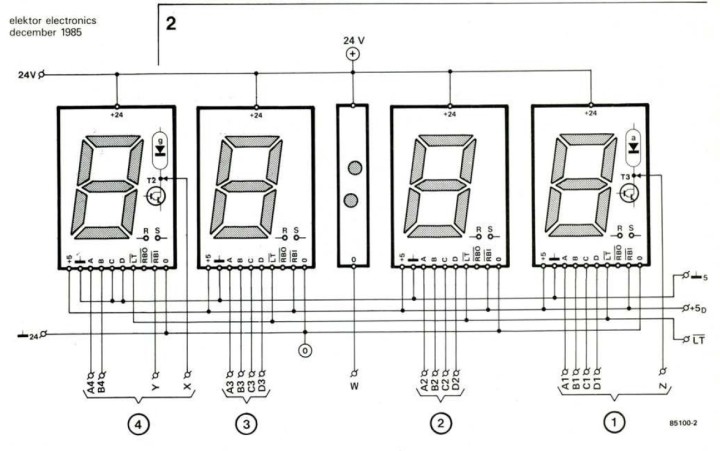
DYI clocks have always been popular among Elektor readers. Check out this jumbo clock design from December 1985. The display, which is readable at a distance of up to 100 m away, shows both the time and ambient temperature (alternately). The diagram below shows the connections between the display and control boards. "Each of the display boards has a BCD to seven-segment decoder ... This decoder converts the BCD codes into control voltages for each individual LED element of the display."
Jumbo clock (December 1985)
More Engineering to Come
In the coming months, we will highlight even more classic Elektor projects and engineering tutorials. Please share your thoughts in the comments section below. The engineering continues!



Discussion (0 comments)