


Neon Lamp Dice: An Elektor Classic!
on
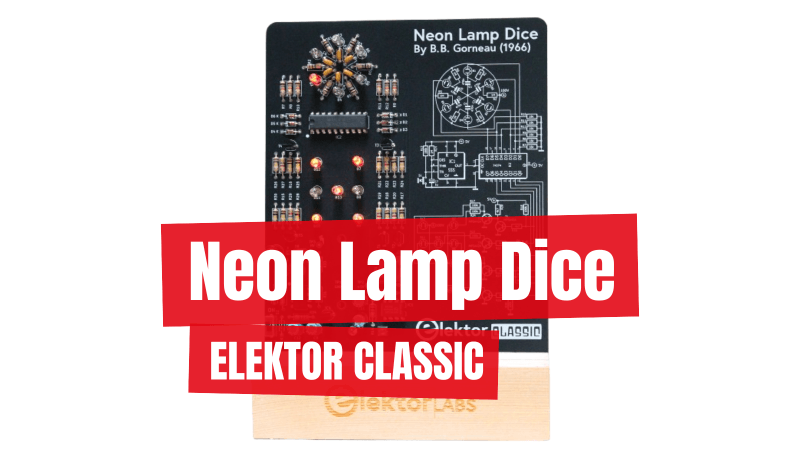
LED-based dice are common, but their light is cold. Not so for this electronic die, which displays its value with the warm glow of neon lamps — perfect for playing games on cold, dark winter evenings.
A neon lamp is a curious device. It behaves like an open circuit when not conducting. When it starts conducting, the voltage across it drops significantly and remains fairly constant over a wide current range. This negative-resistance property allows a neon lamp to be used in, for example, relaxation oscillators. The circuit shown here is based on a semi-random ring counter that was popular in the sixties.
Random Blinking
The counter operates as follows (see Figure 1): The supply voltage, about 100 V, is sufficient to trigger the neon lamps B1 to B6. When this happens for one of the lamps, the voltage across the bulb drops to around 60◦V. This voltage drop is transmitted through the capacitor connected in series with the lamp to the central capacitor node, causing the voltage...