Back in May 1982, Elektor published a matchbox radio project that pushed the limits of miniaturization. Built into a compact box, the fully functional AM radio was powered by the then-novel Ferranti ZN414 IC.
Back in May 1982, Elektor published a matchbox radio project that pushed the limits of miniaturization. Built into a compact box, the fully functional AM radio was powered by the then-novel Ferranti ZN414 IC.
The Matchbox Radio Circuit
Miniature radios were not new in the early '80s. From watch radios with wrist-strap antennas to bulky kits with poor sensitivity, compactness often came at the expense of performance. But Elektor’s matchbox MW radio rewrote the rules. The design offered solid reception, decent volume, and selective tuning, all in a package that could fit in your pocket.
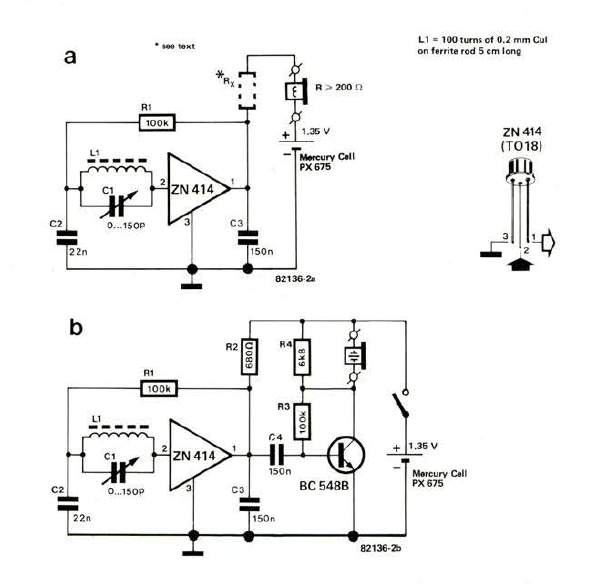
The basic circuit (a) uses a high-impedance magnetic earpiece. An output stage
is required if a crystal earpiece is used (b).
At the heart of the matchbox radio design was a compact Ferranti ZN414. The three-pin IC that integrated: a high-impedance input stage; RF amplifier; AM detector; and automatic gain control (AGC). The chip allowed for circuit simplification. All that was required externally was a tuning capacitor and an aerial coil. Its ultra-low power consumption — just 0.3 mA — made it ideal for battery-powered use, including a tiny 1.35-V mercury cell.
Why a Matchbox?
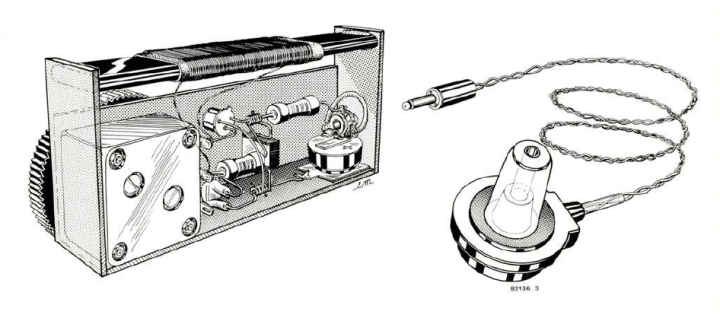
Why not! “The choice of housing is left to the reader as it will depend on the size of the components,” Elektor wrote in the original article. “The prototype was inserted into a matchbox simply as a guide-line and to give an impression of its relatively small size. The original design has a flat ferrite rod, 50 mm in length with a cross-section of 12 × 4 mm, but any rod approximately 10 mm in diameter will suffice.”
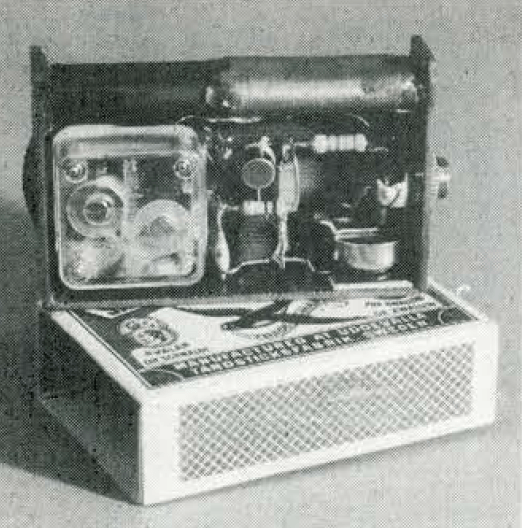
Check out the matchbox radio. The "chassis" was made from plastic.
The Elektor prototype used a plastic inner frame that fit neatly inside the matchbox. Even with the tuning capacitor, ferrite rod, and earphone socket, the compact layout made it remarkably pocket-friendly. Power was delivered via a PX675 mercury cell, and the headphone jack cleverly doubled as a power switch. No PCB was required as components were directly soldered!
The matchbox radio project.
The result was an incredibly small radio with surprising reception and playtime — up to 500 hours on a single battery.
The Original Project
The original “Miniature MW Receiver” article appeared in Elektor May 1982. You can download the article for free during the two-week period following the publication of this news item. If you start an interesting matchbox radio project of your own, please share your progress on the Elektor Labs platform!
Editor's Note: This article originally appeared in a 1982 edition of ElektorMag. Some components or products may no longer be available. However, we believe the project will inspire you to start new electronics projects of your own.
Subscribe
Tag alert: Subscribe to the tag radio and you will receive an e-mail as soon as a new item about it is published on our website!





Discussion (0 comments)