As part of our Elektor 60 celebration, we are regularly spotlighting at stand-out engineering articles, DIY electronics projects, and technical tutorials from the past. Take a look at these articles from previous October editions of Elektor.
As part of our Elektor 60 celebration, we are regularly spotlighting at stand-out engineering articles, DIY electronics projects, and technical tutorials from the past. Take a look at these articles from previous October editions of Elektor magazine. We found them inspiring. Let us know what you think.
Power Outage Detector with Text Messaging (2018)
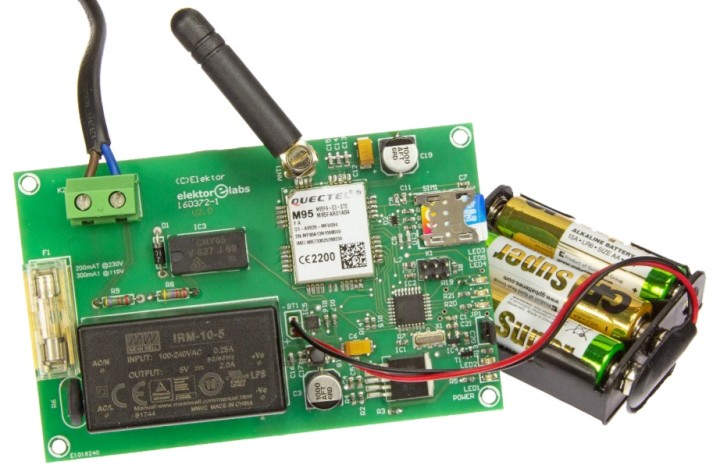
A power outage, even a short one, can be costly. But if you are an engineer and maker interested in DIY electronics projects, you can build their own power outage detector. Spend a little time today to save yourself a lot of money (and hassle) in the future. The design presented in this article will detect power outages (short or long) and then send you text message alerts.
The black power supply module, the white GSM module, the SIM card and the backup battery are clearly visible.
The circuit is built around an Atmel ATmega328P microcontroller. And the firmware provides the following functions: text message on power outage; text message on power restoration; text message when the backup battery needs to be replaced (<3.9 V); text message when the backup battery is empty (<3.7 V); operation in low-power mode during power outage after sending the text message; configuration of phone number for sending alerts by text messaging; and configuration storage in EEPROM.
XMEGA Web Server Board: Display, SD card, Ethernet, RS-485, buttons and LEDs (2013)
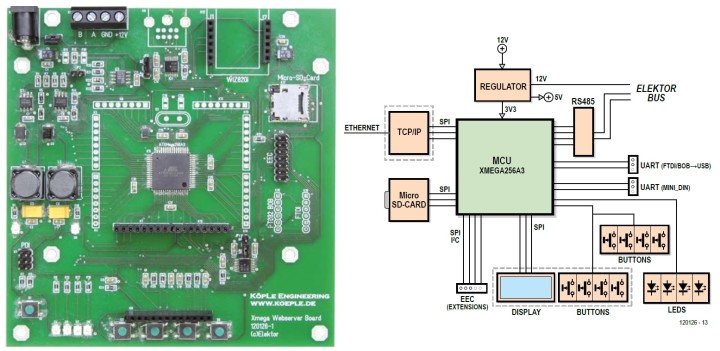
The XMEGA Web Server Board is well suited for monitoring and control applications. The plugin TCP/IP module enables you to implement a web server, other network-oriented applications, and a microSD card provides mass storage. Four LEDs, four buttons, and a removable display provide the user interface options. And, of course, the board comes with a wide range of external interfaces.
The design features an ATxmega256A3, four pushbuttons, and four LEDs.
"It is useful to have a display connected to the board if it is to be used at the center of a monitoring and control application," Jens Nickel wrote. "But not all applications will need a display, and so we have made it a separate module that can be fitted to the controller board if required. This also gives the option of mounting the display elsewhere, for example in a separate enclosure."
The Web Server Board is built around an ATxmega256A3, which “has 256 KB of flash memory and 16 KB of RAM, as well as a few nice extra features such as an advanced event system.” Extensive use is made of the microcontroller’s I/O facilities, including three SPI modules, three UARTs and an I2C module.
ElekTrack: Tracking & Tracing with GPS (2007)
Back in 2007 when commuters were driving around with TomTom nav systems, Elektor published an interesting article about the ElekTrack system. It was an innovative DIY solution.
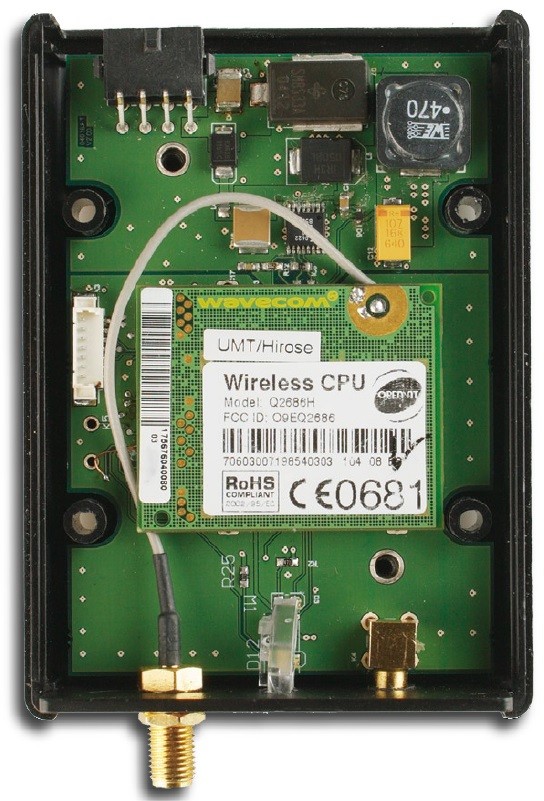
"We developed the ElekTrack to give our readers an opportunity to experiment with GPS tracking," Chris Vossen wrote. "Due to the large number of SMD components and the difficulty of soldering such components, we decided to supply this module fully assembled only."
ElekTrack for DIY tracking and tracing with GPS.
Need your location? ElekTrack can send a text message via SMS with the unit's longitude, latitude and altitude data.
Touch-Free Light Switch: Wave the Lights On and Off! (1997)
Elektor has been presenting readers with touchless control solutions for decades. Back in 1997, we published a touch-free light switch design that enabled user to control lights with a wave of a hand.
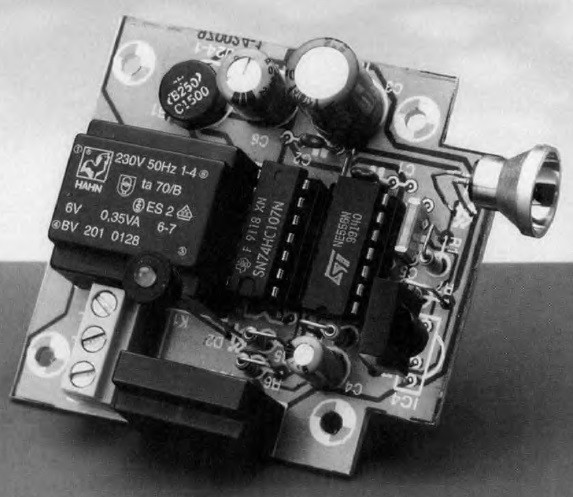
"You no langer have to actually touch the light switch - all you have to do is wave your hand in front of it," the designer explained. "The advantages? No more dirty fingerprints on the light switch in the cellar or garage, and no more danger of an electrical jolt if you operate a light switch in a bathroom or other 'moist' area."
Engineering can simplify things. Check out this touch-free light switch.
The principle of operation is straighforward: a hand reflects enough infrared light to trigger an etectronic switching circuit. Half of the 556 dual timer chip is used in the transmitter; the other half is in used in the receiver. A solid-state relay (SSR) is used for contactless switching of a mains load.
Wideband Active Antenna for 10 kHz - 220 MHz (1992)
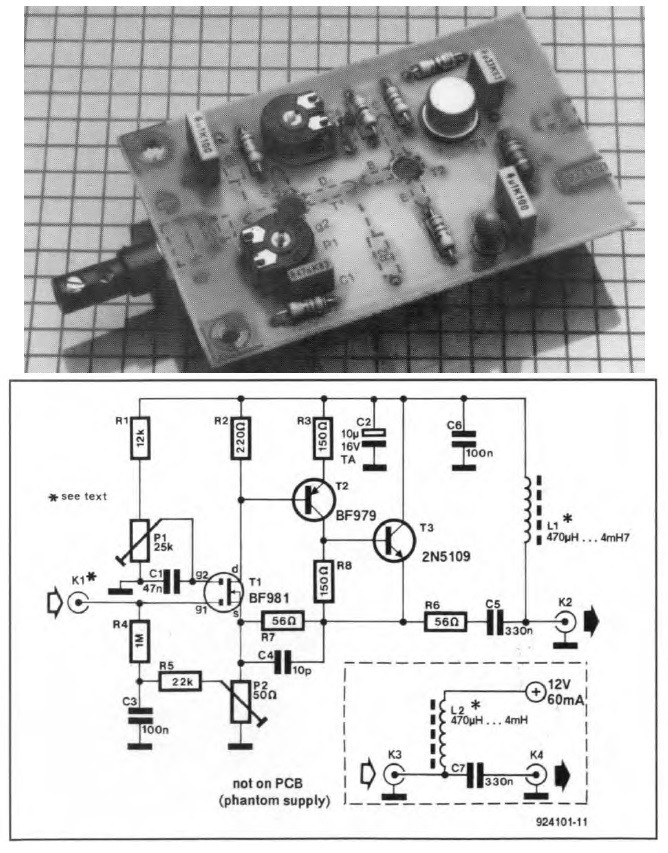
Almost 30 years ago, Elektor presented a design to show that low noise and substantial amplification can go hand in hand in a single amplifier with excellent wideband characteristics. Ideal for use with car radios and communication receivers of the time — or as an active probe for a high-frequency sampling oscilloscope — the design was simple to build from a handful of components.
Wideband Active Antenna
"The amplifier discussed here is one of the 'overall feedback' type, of which every one of the three stages provides amplification. Actually, it is a two-stage amplifier with an emitter follower at the output."
Ultrasonic Distance Meter (1988)
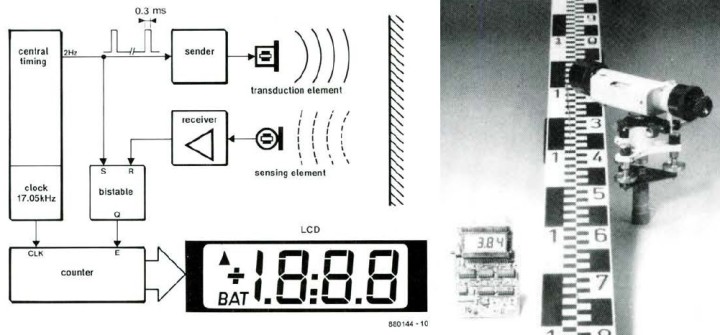
The ultrasonic rangefinder featured in this article is suitable for measuring distances between 25 cm and about 6 m. The measured distance is shown on a three-digit LCD. The low current drawn by the unit makes battery operation possible: a "LO BAT" reading on the LCD indicates when the battery needs to be replaced.
Ultrasonic distance meter
The meter has four main parts: a sender, a receiver, a timing and time reference section, and a counter with display.
"The accuracy of the measurement depends on the precision with which time is measured and on the ambient conditions. The speed of sound depends on the atmospheric pressure, the temperature, and the air density."
Using the Junior Computer as a Voltmeter (1981)
With the addition of a small circuit and the aid of an accompanying program, the Junior Computer can be used as a digital voltmeter. This article details how the voltmeter has 3% digits and an automatic polarity indicator, even though the program is less than 180 bytes long.
"The basis of the circuit is an A/D converter from Intersil. This IC has binary outputs and will convert the input signal level into the BCD code. Since the IC has tri-state outputs, it is suitable for use with microprocessors."
An Introduction to the TV Scope (1978)
Back in the 1970s, oscilloscopes were pretty expensive. Much of the cost was associated with the cathode-ray tube and its associated high-voltage power supplies. In 1978, Elektor published an interesting article about using a TV set as a display.
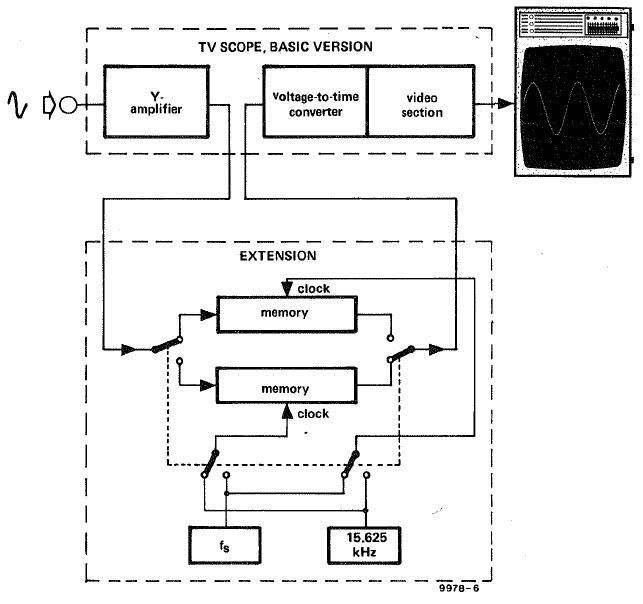
The block diagram of the extended version of the TV scope.
"The TV scope can best be explained by imagining the TV as turned on its side, so that the spot is swept vertically up and down the screen. The signal trace is composed of a series of discrete spots, one per line of the frame. The point on the line where the spot appears is proportional to the amplitude of the input signal. For the sake of simplicity, only a few lines are shown."
More Engineering to Come
These are just a few of the thousands of classic Elektor electronics projects and engineering tutorials our members can enjoy. Next time, we'll highlight a few of the editorial team's favorite engineering articles from past Octobers. The engineering never stops. Take out an Elektor membership to start enjoying the entire Elektor library.



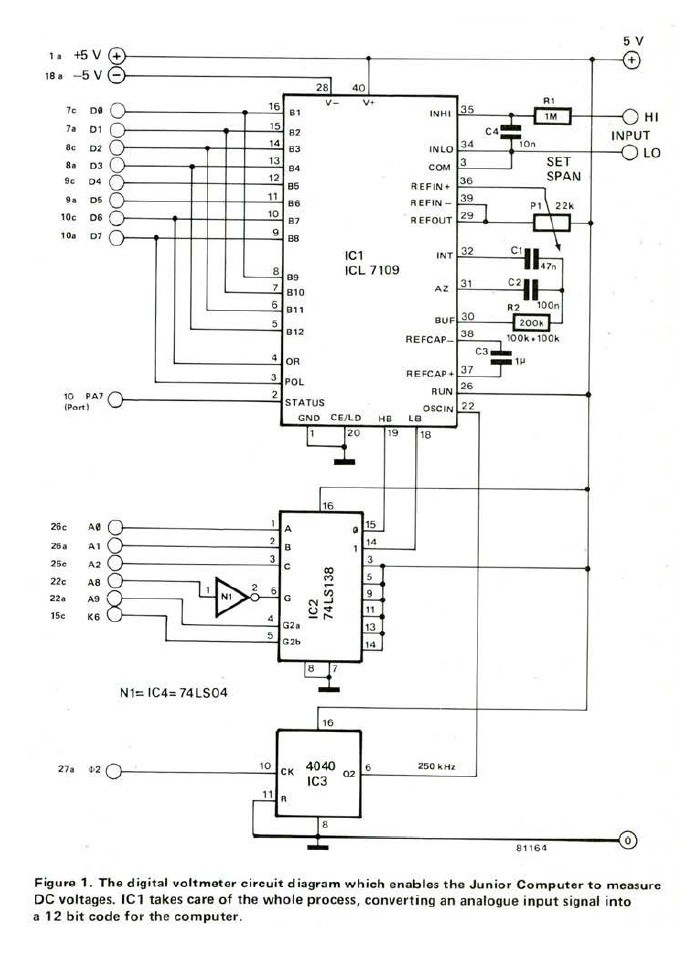 "The basis of the circuit is an A/D converter from Intersil. This IC has binary outputs and will convert the input signal level into the BCD code. Since the IC has tri-state outputs, it is suitable for use with microprocessors."
Discussion (0 comments)