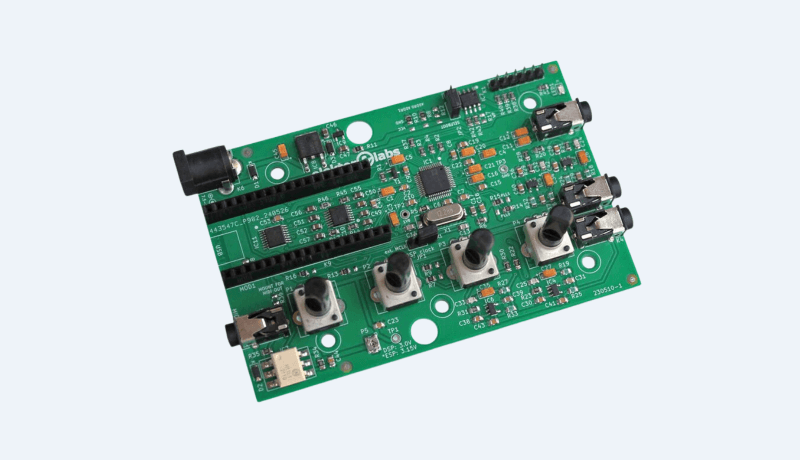
The Elektor Audio DSP FX Processor pairs an Espressif ESP32 microcontroller with an ADAU1701 Audio DSP from Analog Devices. It brings together high-quality audio inputs and outputs with a built-in DSP for audio processing. Unlike many similar boards, this one stands out because its integrated DSP can handle audio tasks independently, giving you both power and flexibility.
The ElektorAudio DSP FX Processor pairs an Espressif ESP32 microcontroller with an ADAU1701 Audio DSP from Analog Devices. It brings together high-quality audio inputs and outputs with a built-in DSP for audio processing and a powerful dual-core 32-bit ESP32 MCU with wireless capabilities. Unlike apparently similar boards, this one stands out because its integrated DSP can handle audio tasks independently, giving you both power and flexibility.
Applications of the Audio DSP FX Processor
The Elektor Audio DSP FX Processor is incredibly versatile. You can use it for Bluetooth and Wi-Fi audio streaming, building guitar effect pedals, or designing music synthesizers. It’s also useful for sound generation, advanced audio effects like reverb and pitch shifting, and programmable crossover filters. It’s suited for internet-connected audio devices, DSP experimentation, and wireless MIDI setups or MIDI-to-CV conversion. The possibilities are endless. Fully Assembled Board.
The Audio DSP FX Processor board runs on open-source software, offering you the freedom to adapt it to your audio projects. Whether you’re interested in using the provided library or exploring new applications, there’s plenty of information available to help you. For more details check out the Elektor Labs project page or visit the GitHub repository.
Key Features and Specifications
The Elektor Audio DSP FX Processor offers a range of useful features for high-quality audio applications. Here’s a quick look at its key specifications:
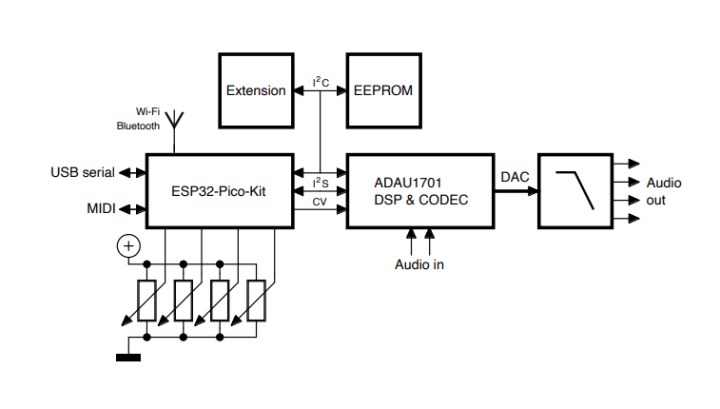
Supports Wi-Fi and Bluetooth: Suitable for, among other things, audio streaming and remote development of DSP programs.
I²S Bus: This handles audio signal transfer between the ESP32 and the DSP. If the DSP is managing all the audio processing, as it can, the ESP32 is free to handle other tasks.
I²C Bus: This lets you control the DSP from another processor, like the ESP32 or an Arduino UNO. We chose I²C because it is easier to expand.
EEPROM: The board has an EEPROM that stores and loads DSP programs. The ESP32 can load this EEPROM with new DSP programs from a computer, either wirelessly or via USB.
Analog Signal Bus: This bus runs from the ESP32 to the DSP and deals with analog signals used to adjust parameters within DSP algorithms. It has four channels and can be controlled by potentiometers or by the ESP32’s firmware.
Audio I/O Bus: Includes two input channels and four output channels. Outputs are filtered through passive or active filters, while inputs are processed within the DSP.
Additional Features: The ESP32 also includes a USB-to-serial converter and a MIDI input/output.
You can see how these components and their connections are organized in the block diagram below.
The block diagram of the Audio DSP FX Processor contains two main blocks: an ESP32 processor and a DSP.
Subscribe
Tag alert: Subscribe to the tag Audio and you will receive an e-mail as soon as a new item about it is published on our website!





Discussion (1 comment)