Elektor Lab Notes 12: A Digital Ammeter/Voltmeter, Quartz Crystal Testing, and more!
Check out the latest installment of Elektor Lab Notes. We cover some of the latest projects we are working on, including the ESP32 Energy Meter Project, a digital Ammeter/Voltmeter, Wi-Fi remote for audio amplifiers, quartz crystal testing, and more!
Welcome back to Elektor Lab Notes! Every few weeks, our engineers and busy editors post a few lab notes and updates about new DIY electronics projects, industry news, and helpful engineering tips. This time, we present updates about the ESP32 Energy Meter Project, the AmpVolt Project, detailsa bout quartz crystal testing, a remote control for audio amps, and more. Please share your thoughts in the Discussion section at the bottom of this page. You can post your own lab notes and let us know what you are working on at your electronics workbench!
Saad Imtiaz (Senior Engineer, Elektor)
ESP32 Energy Meter Project: The PCBs have arrived, and I'm currently in the midst of testing them. Stay tuned for updates on how these boards perform in real-world conditions.
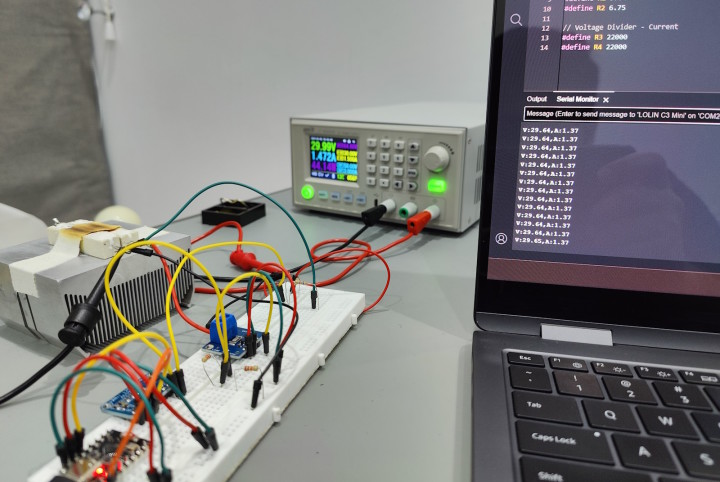
AmpVolt Project: Working alongside Jens, we've developed a modular current and voltage measuring module. It's designed for flexibility, incorporating an ADS1015 ADC for digital conversion, an INA169 for current measurement, and a voltage divider for sensing up to 50V. PCB design is complete, and testing is on the horizon.
Early testing!
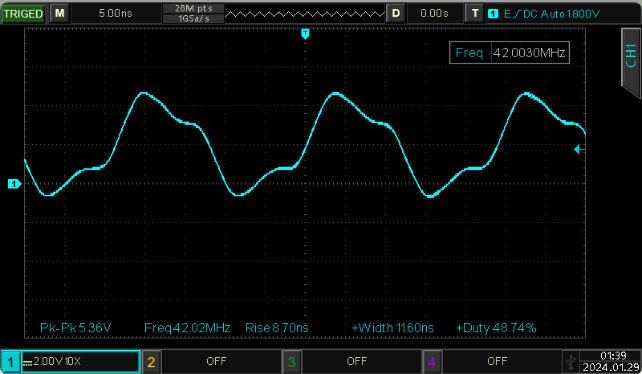
Benchmarking Microcontroller Boards: Inspired by the limitations of my function generator, I thought to start a benchmarking quest to create the fastest square waves possible with microcontroller boards. The results were surprising and will be detailed in the upcoming editions of the Elektor Magazine.
STM32-STM32F407 generating "square waves" at 42 MHz.
Subscribe
Tag alert: Subscribe to the tag Elektor Lab Notes and you will receive an e-mail as soon as a new item about it is published on our website!
Jean-François Simon (Engineer, Elektor)
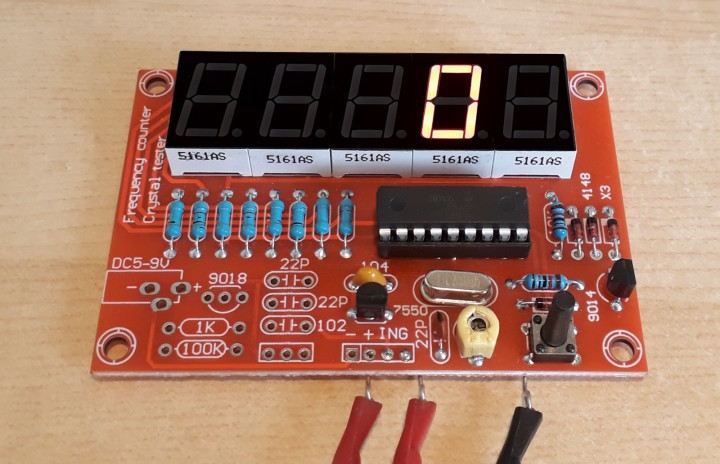
Quartz Crystals: the other day, I was assembling a small PIC-based kit to make a small 5-digit frequency meter. These are clones of Wolfgang "Wolf" Büscher's (DL4YHF) original circuit. Once soldered, the device is powered on: all display segments switch on briefly, then the display shows "0" and the current consumption remains under 5mA. All good.
The unpopulated components on the left are part of a crystal tester that has known issues, so I left it out.
Then I realize I did not solder the crystal straight, but a little bit sideways. This has no functional impact but it triggers my OCD a little bit, so I reflow the soldering and put it back straight. Next test: nothing happens! No current consumption, nothing on the display. Long story short: the crystal is not oscillating. Conclusion: the simple fact of re-soldering it and thus heating it a little longer than necessary was enough to kill it completely. It's the first time this has happened to me...
I had bought two units, which enabled me to confirm the diagnosis: with the second crystal, the circuit worked normally again. Lesson learnt: these components are fragile, not only to shocks, but also to temperature! Unless I've been the victim of a manufacturing defect?
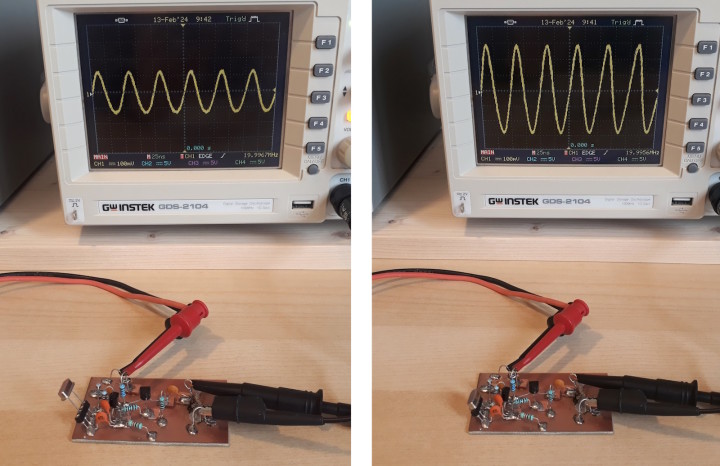
More testing: this incident made me want to investigate further. So I made the buffered Colpitts oscillator from the book "Experimental Methods in RF Design" which is presented in this video. Sure enough, the crystal in question doesn't oscillate. I've checked a few other ones in my collection (4, 8, 12, 16, 20 MHz), and they all oscillate. As the frequency increases, the output amplitude decreases, I think this is normal and due to the design of this particular oscillator circuit.
Left: crystal from the Frequency Counter kit, Right: crystal from my parts drawer.
As a side note, I found that the crystal supplied with the kit is the one which gives the lowest amplitude (260 mVpk-pk) of all the ones I've tested. The other ones I had gave an amplitude of around 600 mVpk-pk. Could this be the consequence of cheaper-than-average manufacturing?
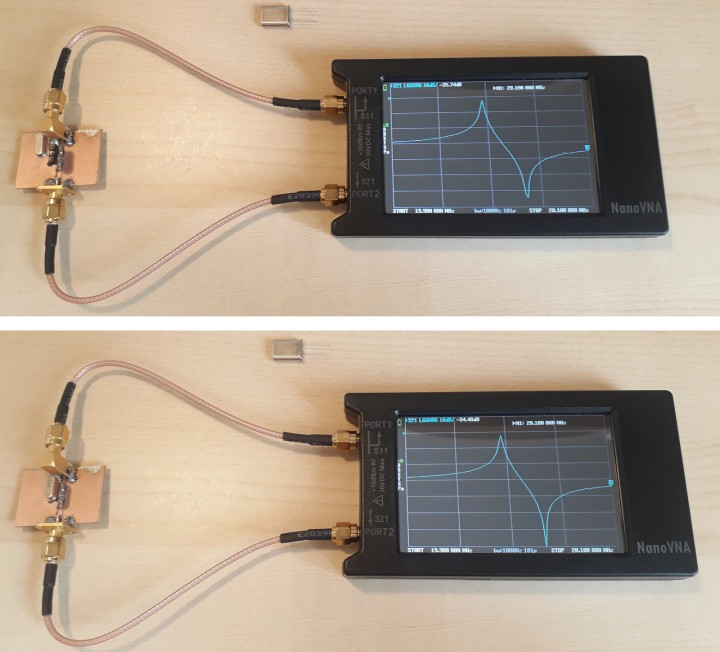
Even more testing: By using a cheap VNA (here, the NanoVNA H4), one can see the two resonant frequencies of the crystal: first the series resonant frequency, then the parallel resonant frequency. Here the sweep was from 19.9 MHz to 20.1 Mhz and s21 is displayed. Interestingly, the broken crystal that doesn't oscillate still shows a frequency response very similar to the working one. So, while it’s very interesting to study various circuits, the NanoVNA alone is not enough to determine if a crystal is working properly or not.
Top: OK crystal from the Frequency Counter kit, Bottom: broken crystal. No significant difference on the VNA.
Calibration Standards: while I was looking for documentation on how to use my nanovna properly, I came across this blog post from a few years ago (but some types of content never get old). There, Andrey makes a nice set of Open, Short and Load standards for his VNA, using BNC connectors. These are of course limited in frequency compared to their SMA counterparts, but they are quicker and easier to connect. Nice work!
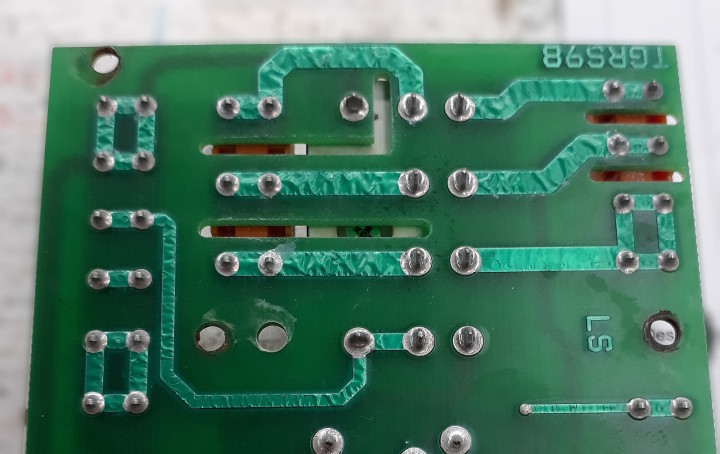
Wrinkles on PCBs: did you come across an old PCB like this?
Are these tracks going to fall out? Fortunately not.
I did, and I wondered what was wrong. Are the copper tracks delaminating from the epoxy? Is this due to aging? Well, in fact, nothing to worry about. These wrinkles are due to the manufacturing process. The PCBs concerned date from the 1980s. At the time, the Solder Mask Over Tinned Copper process (SMOTC) was commonplace. Tin-plating the tracks gave these irregular surfaces, and the solder mask, when applied over them, took on this appearance. PCBs manufactured today use the Solder Mask Over Bare Copper process (SMOBC), and are therefore smoother. See you in the next installment of Lab Notes!
Jens Nickel (Editor-in-Chief, Elektor Magazine)
Wi-Fi Remote Control for Audio Amplifiers: I've already shared updates on my latest hobby project, which is a remote control for off-the-shelf, yet slightly modified Class D audio amplifiers. It features an independent battery power supply and wireless receivers for audio. Gradually, the setup for Version 1 (focusing mainly on remote volume control) is taking form.
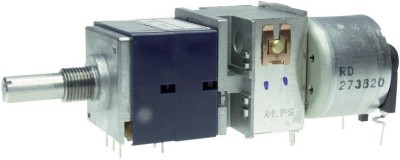
A friend and I are utilizing Alps motorized potentiometers and off-the-shelf I²C “Mini Motor Controller” boards from the Grove system by Seeed Studio. Additionally, we're tracking the potentiometer position using an I²C ADC, specifically the 12-bit ADS1015, to enable a form of feedback for our volume control. While there are numerous ADS1015 breakout boards suitable for breadboards, there are not many affordable extension boards with user-friendly connectors. Therefore, we plan to design our own simple extension board with Grove connectors.
ALPS motorized potentiometer. Source: Conrad.
Although many connector systems exist for rapid prototyping with modules, I'm particularly fond of the Grove system. It is specified to be compatible with I²C, UART, as well as analog and digital signals, plus you can find compact extension boards for microcontrollers equipped with Grove connectors. For instance, check out this one. It can be used, for example, with both a SAMD21 and an ESP32 controller.
Initially, my buddy wasn't thrilled about the Grove connectors being proprietary and having a 2-mm pitch, which doesn't match the standard veroboards (finding 2-mm versions is a hassle and they're quite expensive). But we are both very committed to open-source and we took this as the perfect opportunity to learn how to use KiCad. After a few weeks, we really started to enjoy it a lot. I'll continue to update you in the next lab notes!
Subscribe
Tag alert: Subscribe to the tag Power & Energy and you will receive an e-mail as soon as a new item about it is published on our website!
C. J. Abate (Director, Content and Engineering)
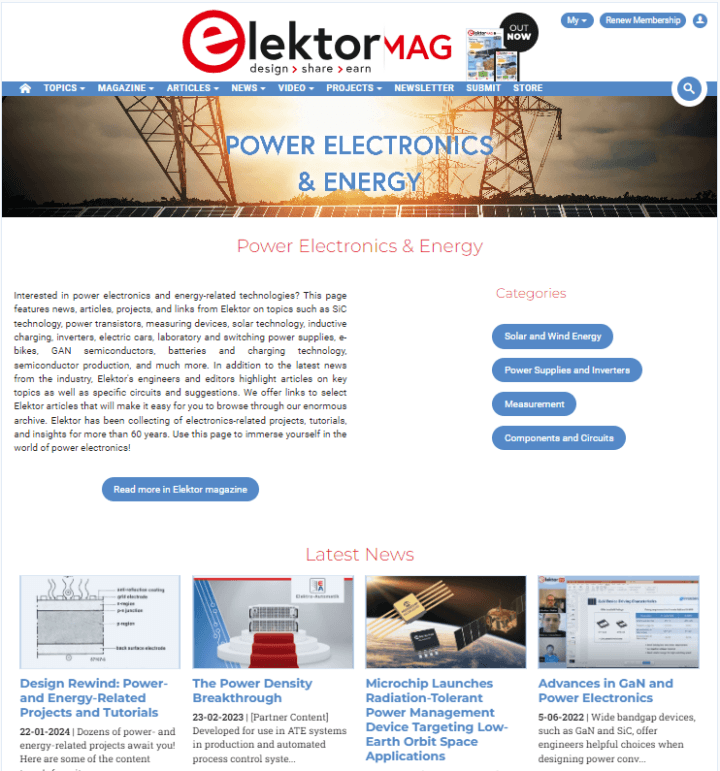
The Jan/Feb edition of ElektorMag focuses on power- and energy-related topics. In addition to the magazine, we are also maintaining a webpage dedicated to Power & Energy. Check it out! Engineers Jens Nickel and Thomas Scherer manage the page, which you can bookmark and check regularly for news, projects, and articles on a wide variety of power- and energy-related topics: solar and wind energy, power supplies and inverters, power measurement, and components and circuits.
A quick reminder: In 2024, our Content Team will focus its content creation efforts on educating community members about specific electronics-related subject areas (i.e., "verticals"). The key verticals include: Power & Energy; Embedded & AI; Test & Measurement; IoT & Sensors; Circuits & Circuit Design; Wireless & Communications; Prototyping & Production; Arduino; Espressif; and Raspberry Pi. We encourage your active participation and collaboration. Please submit your article proposals, showcase your projects on the Labs platform, and share your product ideas with us. We look forward to collaborating with you!





Discussion (0 comments)