Elektor Lab Notes: Elektor X, a Secret Circuit, and a PCIM Update
It has been a busy few weeks for the Elektor Lab Team. We have a new lab! Here are details about a few of our recent projects and initiatives.
Welcome back to Elektor Lab Notes, where we regularly update you about many of the engineering and editorial projects on our workbenches and desks. Before I share notes from some of our engineers and editors, I will update you about a few of the items that I mentioned last time.
Elektor X at LabAix Aachen
On Tuesday, May 18, 2022, Elektor officially opened its new lab space located at LabAix in Aachen, Germany. Elektor engineers, editors, and colleagues celebrated the opening of the new workspace with a barbeque, drinks, and great conversation.
Elektor employees celebrating the opening of a new Elektor Lab at LabAix Aachen,
The new workspace includes workspaces for engineering, editing, and business meetings. The Elektor lLab is stocked with test requipment, boards, hand tools, and several classic elektor circuits and designs. It's serves as a video studio, where our engineers can livestream shows (e.g., Elektor Lab Talk) and record editorial webinars.
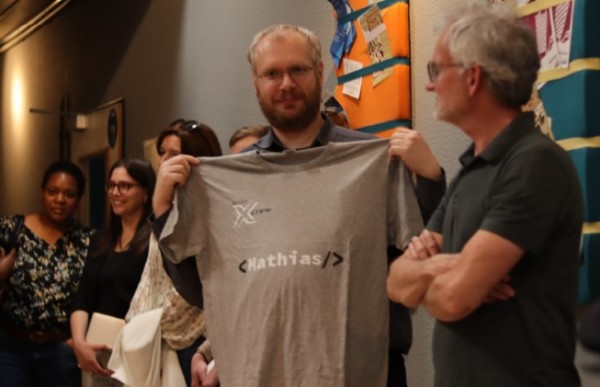
Elektor Lab engineer Mathias Claussen shows off his new Elektor X t-shirt!
Launched in January 2022, Elektor X is an initiative to give the Elektor Lab Team more time to regularly innovate, test, engineer, and collaborate without the usual workaday distractions. The Elektor X team comprises Elektor's core technical and editorial staffers, all of whom are focused on developing new designs and projects. Modeled on the idea of a skunk works team, Elektor X team members are meeting for two or more days each month work on projects and to develop new ideas. While we already have a growing list of potential new products, we are always open to new suggestions. Email us or share your thoughts below this article.
Elektor Academy
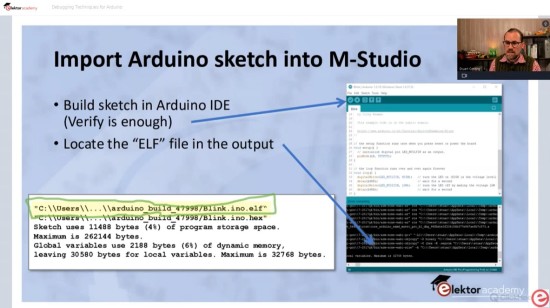
During the past several weeks, we've been busy working on several new Elektor Academy courses. The first live course titled Tips on Debugging Arduino Code, which we offered free of charge, attracted more than 265 attendees from a wide variety of countries, including Germany, the United States, the Netherlands, France, Great Britain, and India.
The recording will be available in the near future. Visit the Elektor Academy page for updates, as well as details about our future courses. The next course, Neural Network for Arduino: Give Arduino a Brain is slated for June 2, 2022. Registration opens soon.
New Elektor Videos: Projects, Wide Bandgap Devices, and More
Interest in Elektor's video content (e.g., webinars, ElektorTV videos, and livestreams) continues to spread. If you missed any of our recent videso, check them out below.
In the second episode of Elektor Lab Talk #2, Mathias Claussen and Jens Nickel talked about rapid prototyping, DIY applications, and more. They touched on ESP32, Arduino, RP2040, and a few Elektor Mag projects.
In the fourth episode of Elektor Engineering Insights, Elektor author Stuart Cording spoke with Anup Bhalla (UnitedSiC, now Qorvo) and Denis Marcon and Yang Jiao (InnoScience) about wide bandgap (WBG) devices, such as GaN and SiC. In addition to touching on what engineers need to know when moving from silicon MOSFETs and IGBTs to the WBG alternatives, they discussed which applications benefit most from WBG.
Clemens Valens (Engineer/Editor, Elektor)
After having them carried around for more than 40 years, I finally hooked up two resolvers and had a look at the signals. When I got them, I didn’t know what they were or how to use them, now I took the time to figure it all out. Even though they are widely used, many people do not really know what a resolver or a synchro is or how they work. If you want to know them better, check out this video in which I try to explain what they are and why you would want to use one.
I also spent some time on designing a printed circuit board (PCB) for a special re-edition of a circuit from almost 20 years ago. As it is supposed to be a surprise for the Summer Edition, I won't reveal here what it is. What I can tell you, though, is that it is a noisy circuit.
Jens Nickel (Editor-in-chief, Elektor)
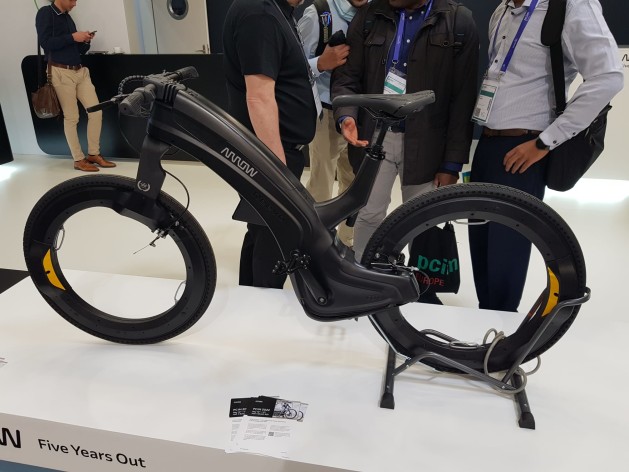
A bike at the Arrow booth at PCIM
A week ago, I visited the Sensor + Test, PCIM and SMT Connect trade shows, which were all held simultaneously at the exhibition center in Nuremberg. After more than two years without visiting a fair, my colleague Büsra Kas from the client department and I were finally able to take a look around the industry in person. The tenor: almost all companies had to find solutions to the problems of the pandemic and chip crisis, the war in Ukraine and the lockdown in China. One of the challenges is to ramp up development and production again, but also marketing activities: There is a shortage of skilled workers in every area. The fact that everything is still a bit slow to start up again could also be seen in Nuremberg; the halls were not filled with exhibitors nor visitors. Nevertheless, I had fun, and I am already looking forward to embedded world in June and electronica in November, where Elektor will participate with its own booth.
By the way, my colleague Stuart Cording was also at PCIM in Nuremberg. He has compiled some interesting reports and interviews, for example on the topic of GaN/SiC. You can see the whole thing in Engineering Insights on May 19th.
More Lab Notes
Thanks for reading this edition of Elektor Lab Notes. Every few weeks, the Elektor Lab Team will post new notes and updates about its design projects, industry news, magazine articles, and engineering tips. Please share your toughts (and your own lab notes) in the Discussion section at the bottom of this page. Stay curious!




Discussion (3 comments)