


New compound paves way for efficient, non-toxic batteries
January 12, 2017
on
on
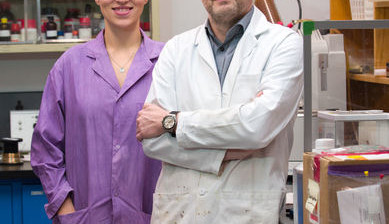
With exploding cell phones making the news lately, many are likely wondering if a better battery is possible. In the Department of Chemistry at the University of Calgary, professor Thomas Baumgartner’s research group is working on tackling that question, by developing a carbon-based battery whose organic components make it a considerably more stable and sustainable alternative. The group develops materials for sustainable energy solutions, converting energy into different forms, storing that energy and using it in various processes. One branch of the research is devoted to "organic" electronics, so named for their addition of carbon-based (organic), plastic materials as an active electronic component. “We’re using these instead of expensive metals,” he explains.
Building upon an organic phosphorus compound and work started by a PhD student in his lab several years back, Baumgartner says his group has now been able to produce a powerful iteration of carbon-based batteries. They recently published their findings in a paper in Advanced Energy Materials.
Because the battery they have created has opened a pathway towards ultimately avoiding the use of more volatile and potentially toxic materials such as lithium, mercury, cobalt, or cadmium typically found in batteries, the innovative product is not only cheaper to produce but is non-toxic, lightweight, and considerably more stable. In a world connected by smartphones, tablets, and laptop computers, these features are highly desirable to the everyday consumer.
Adding to its appeal, the new battery compound is claimed to retain its health even with frequent usage. By hooking up the batteries to a special machine and cycling them through their charging and discharging cycles, the group achieved more than 200 cycles.
For batteries to become commercially viable, they need to reach a capacity of 200 milliampère-hours per gram. The Baumgartner group’s material averages 90 mAh/g. “To optimize the tools to do that, you have to make them lighter or able to accept more charges while keeping the mass constant. These are our next steps,” Baumgartner says.
Source: Erin Guiltenane, UCalgary Faculty of Science
Building upon an organic phosphorus compound and work started by a PhD student in his lab several years back, Baumgartner says his group has now been able to produce a powerful iteration of carbon-based batteries. They recently published their findings in a paper in Advanced Energy Materials.
Because the battery they have created has opened a pathway towards ultimately avoiding the use of more volatile and potentially toxic materials such as lithium, mercury, cobalt, or cadmium typically found in batteries, the innovative product is not only cheaper to produce but is non-toxic, lightweight, and considerably more stable. In a world connected by smartphones, tablets, and laptop computers, these features are highly desirable to the everyday consumer.
Adding to its appeal, the new battery compound is claimed to retain its health even with frequent usage. By hooking up the batteries to a special machine and cycling them through their charging and discharging cycles, the group achieved more than 200 cycles.
For batteries to become commercially viable, they need to reach a capacity of 200 milliampère-hours per gram. The Baumgartner group’s material averages 90 mAh/g. “To optimize the tools to do that, you have to make them lighter or able to accept more charges while keeping the mass constant. These are our next steps,” Baumgartner says.
Source: Erin Guiltenane, UCalgary Faculty of Science
Read full article
Hide full article
Discussion (0 comments)