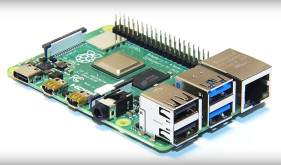
Although we usually expect them to surprise us, the British know how to make a grand announcement. Even their most anticipated surprises remain real surprises. And sometimes very good surprises. So it is with the new version of that celebrated British single board computer that is found everywhere, even hidden within the labs of NASA. The star of the week is Version 4 of the Raspberry Pi.
The FOUR in all its splendour!
If I told you that the Raspberry Pi is a microcomputer that rules everything, even NASA’s famous Jet Propulsion Laboratory , you’d probably be on the way to express your disdain for my predilection for sensationalist news. You’d be wrong, because on the 24th June 2019, it was (very sensationally) announced by the BBC that NASA made public in an audit report the following astonishing information: for 10 months, a Raspberry Pi hooked up to the internal network by an employee of JPL would have been used to hijack restricted (in principle) military and space information.
So when will we see a Raspberry Pi on Mars?
Ten months is a long time! In the life of a Raspberry Pi as well as that of NASA network administrators. Understandably they have not provided many other details, but it seems they concern the security of flight systems of active spacecraft. Everyone knows that JPL is dedicated to space robots and the famous planetary explorer robots. While waiting for the day when we may find a Raspberry Pi as a stowaway on one of these planetary explorers, you will find more precise details on the new Raspberry Pi in the thorough review published in Elektor last week, as well as in the Elektor store, where the now version of this microcontroller is available in three memory capacities (1 GB, 2 GB et 4 GB), and finally in the video below.
Elektor Magazine has been one of the leading sources of information on electronics for engineers, designers, start-ups and companies for 65 years. Our magazine is powered by an active community of electronics engineers – from students to professionals – who are passionate about designing and sharing innovative ideas.
For them, we publish hundreds of items a year, in formats such as articles, videos, webinars, and other learning formats. Our mission is to share knowledge in every possible way and inspire readers with the latest developments within the electrical engineering sector.
Thank you for your vote!
Leave further comments in the fields below.
Thank you for your vote!
If you wish to leave a comment with your rating, please first use the login below. If not, just close this window.
Discussion (0 comments)