When we ask members of Elektor’s community to share details about their electronics workspaces, they typically send us descriptions and photos of workbenches and labs located in their basements, attics, spare rooms, and garages. So, we were a bit surprised when Chalkida, Greece-based hardware engineer Vangelis Gkolgaris told us about his portable electronics lab. Let’s take a closer look.
When we ask members of Elektor’s community to share details about their electronics workspaces, they typically send us descriptions and photos of workbenches and labs located in their basements, attics, spare rooms, and garages. So, we were a bit surprised when Chalkida, Greece-based hardware engineer Vangelis Gkolgaris told us about his portable electronics lab. Let’s take a closer look.
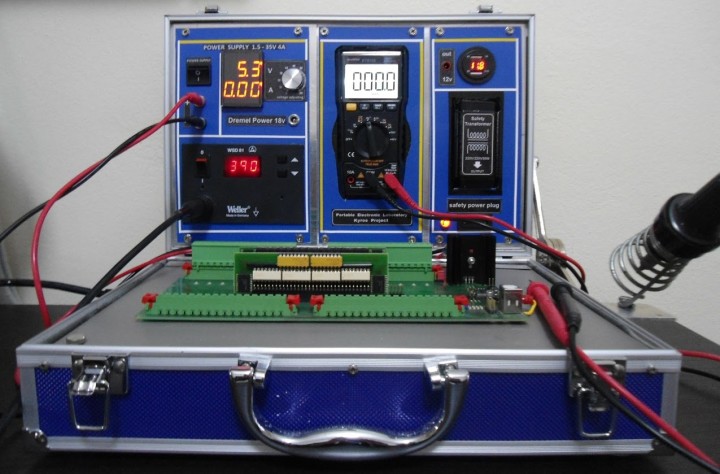
Vangelis Gkolgaris's portable electronics lab
Before you share details about your workspace, tell us about your technical interests. What sort of projects do you work on?
DIY electronics, programming, and Arduino development.
You have an interesting-looking portable electronics lab. Is it something you purchased or built yourself?
It is my own construction, adapted to my needs.
Can you tell us a bit about its size weight? What specific tools are included in your portable electronics lab? What do you use it for?
Dimensions are 35 × 25 × 10 and weight is about 6 kg. It includes a soldering station, DC power supply (1-30V, 4A), a multimeter, isolation transformer (220 to 220 VAC), USB 5V power. I use it for repair and construction work.
How is it powered?
Plug-in power (220-V AC).
Describe to us why you decided on building a portable electronics lab. Did you need it for work? Or were you short on workspace? Some other reason?
Due to limited space. And I changed houses. It’s good for hobby projects.
You’ve had the portable electronics lab for 10 years. Have you had to make any major upgrades or changes during that time?
Yes. I have built two or three similar laboratories in the upgraded frames.
You indicated that you are planning a new portable electronics lab. Can you share some details about your plans? What will it include?
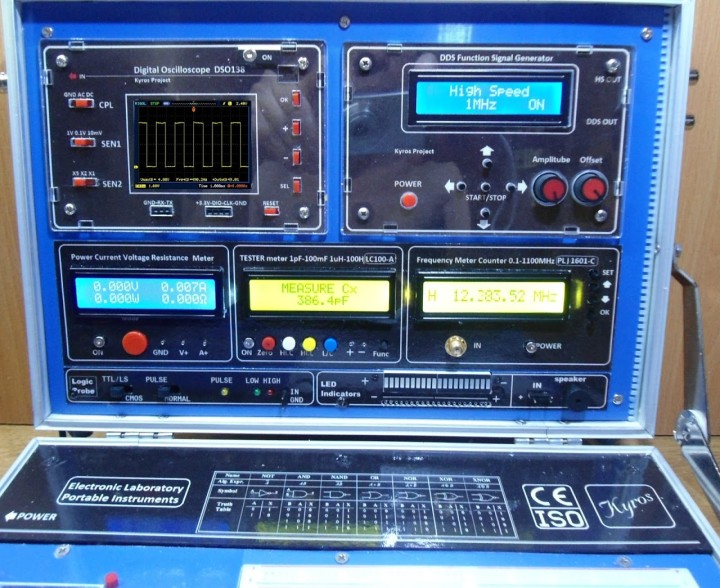
I will include a better multimeter with an oscilloscope, a dual power supply 2 × 0-30v DC 3A, an electric vacuum solder sucker desoldering gun, and the same welding station. I will use a slightly larger suitcase and it will be 2 kg heavier. I plan to start construction in early 2021.
Do you have any advice for other engineers or makers who are thinking of putting together a workspace?
Perform your hobby wherever you can!
This portable system has an oscilloscope, DDS functional signal generator, and more!
If you enjoyed learning about Vangelis Gkolgaris's portable electronics lab, take a look at these other workspaces!
Do you have a portable electronics lab? Show Us!
We want to know about your electronics workspace. Ready to share details with Elektor's global community? Fill out this online form so our editors can contact you!



Discussion (0 comments)