


Review: Espressif ESP32-PICO-KIT Getting Started Guide
Windows users
Applications for the ESP32-PICO-KIT can be developed on Windows, Linux or Mac. Actually, it is a GNU-tools-based environment that can be run on Windows in a Unix shell like MSYS2, on Linux and Mac this is, of course, not necessary. Although it is possible to set up such a system by yourself — instructions to do so are available — the people at Espressif have made available a preconfigured MSYS2 download, simplifying the installation process considerably.Preconfigured toolchain
Download the preconfigured MSYS2 plus toolchain archive. Unzip the 500+ MB zip file to some place on a hard drive where you can find it. Navigate to the folder that contains the file mingw32.exe and run it. You will now be in a UNIX-like environment; all the commands that follow are to be entered in this shell.Linux and Mac users
may first have to install some support packages before installing the toolchain. Detailed instructions for Linux and detailed instructions for Mac.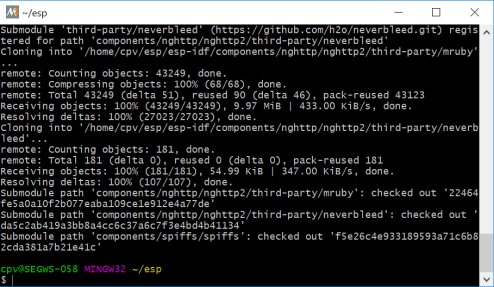
Everybody: install the IDF
After installing the toolchain (and MSYS2 for Windows users) the ‘IDF’ must be installed. IDF stands for ‘IoT Development Framework’ and it contains the libraries, examples and documentation. Here are the instructions for a non-custom, plain-vanilla installation of ‘esp-idf’:
mkdir ~/esp
cd ~/esp
git clone --recursive https://github.com/espressif/esp-idf.git
Set the path
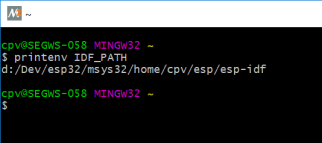
Next it is necessary to set the path to the IDF folder, which depends on your system, of course. On Windows systems create the file <..>\msys32\etc\profile.d\export_idf_path.sh (where “<..>” must be adapted to your system). Put in this file the line:
export IDF_PATH="your -absolute-path/esp/esp-idf"
where “your -absolute-path” must be adapted to your system. You can create the file and write it in the MSYS2 shell with one single command (note the usage of single and double quotes):
echo 'export IDF_PATH="your -absolute-path/esp/esp-idf "' > ../../etc/profile.d/export_idf_path.sh
Path on Linux and Mac
Linux and Mac users should open the file
~/.profile
and add to it the line
export IDF_PATH=~/esp/esp-idf
Read full article
Hide full article
Discussion (0 comments)