Step-Down Converter from 48 V to 5 V: The Story of a Circuit Development
on
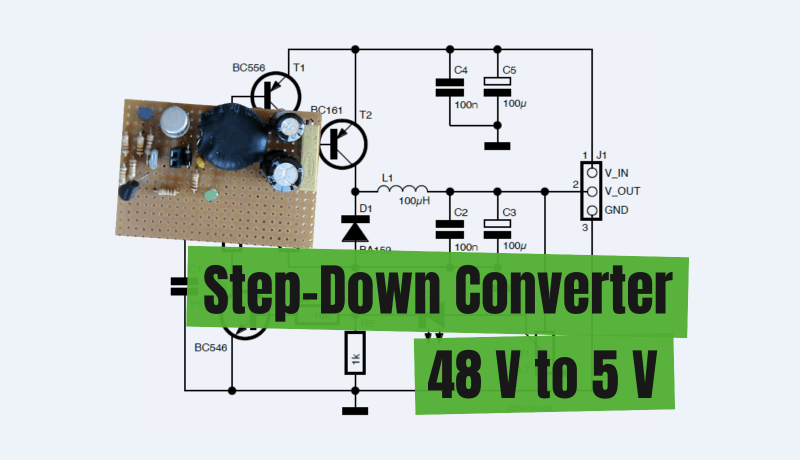
To power a microcontroller, I need a voltage between 3 and 5 V, but only a 48 V battery is available. There are very few ready-made modules or ICs capable of handling such a high DC voltage. So why not design a circuit myself? The first idea was a classic step-down converter controlled by a multivibrator as pulse generator. Since the battery voltage is fairly constant, an unregulated version would be sufficient. The voltage could be coarsely adjusted via the duty cycle.
Eight Steps to a Prototype
1. Component Selection
Due to the relatively high input voltage, standard op-amps or transistors like the BC547 cannot be used. Still, I wanted to work only with parts already in my inventory. After rummaging through the stock and consulting datasheets, the following components proved suitable:
- BC546 (NPN) and BC556 (PNP) for small-signal processing
- BC161/16 or BD138 as PNP power transistor (possibly replaceable by a BC556 for low currents)
- 100-µH inductor salvaged from a dismantled ...