


New development platform for automotive electronic control units
March 25, 2017
on
on
AUTomotive Open System Architecture (AUTOSAR) is a worldwide automotive consortium trying to create and establish an open and standardized software architecture for automotive electronic control units (ECUs). However, as is always the case with industry consortiums and standards, they are not endorsed by all interested parties, and, to complicate matters even more, not all applications require AUTOSAR.
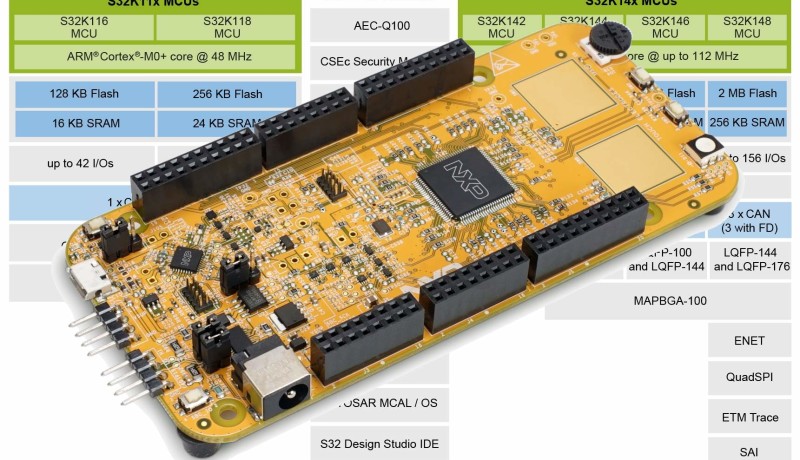
With this in mind NXP has launched its S32K1 family of scalable ARM Cortex-M devices together with a suite of automotive grade tools and software. Initially the family will span 128KB-2MB of flash memory. All family members include ISO CAN FD, CSEc hardware security, ASIL-B support and ultra-low-power performance.
In applications where the use of AUTOSAR is not mandated, the S32K platform provides a path for self-development with a free-of-charge, pre-qualified, automotive-grade software development kit (SDK) that enables rapid prototyping with simple drag and drop functionality. For AUTOSAR applications, NXP’s MCAL and OS support has been expanded with new Complex Device Drivers (CDD) and a new S32K starter kit is available free of charge for evaluation.
With this in mind NXP has launched its S32K1 family of scalable ARM Cortex-M devices together with a suite of automotive grade tools and software. Initially the family will span 128KB-2MB of flash memory. All family members include ISO CAN FD, CSEc hardware security, ASIL-B support and ultra-low-power performance.
In applications where the use of AUTOSAR is not mandated, the S32K platform provides a path for self-development with a free-of-charge, pre-qualified, automotive-grade software development kit (SDK) that enables rapid prototyping with simple drag and drop functionality. For AUTOSAR applications, NXP’s MCAL and OS support has been expanded with new Complex Device Drivers (CDD) and a new S32K starter kit is available free of charge for evaluation.
Read full article
Hide full article
Discussion (0 comments)