


Raspberry Pi Ban at Zoran Mamdani’s NYC Mayoral Inauguration
on
The Raspberry Pi ban at New York City’s 2026 mayoral inauguration is real. It is not satire. It is not a parody website. It is listed, by name, alongside explosives, drones, weapons, and laser pens on the official prohibited items list for the public block party celebrating the city’s incoming mayor.
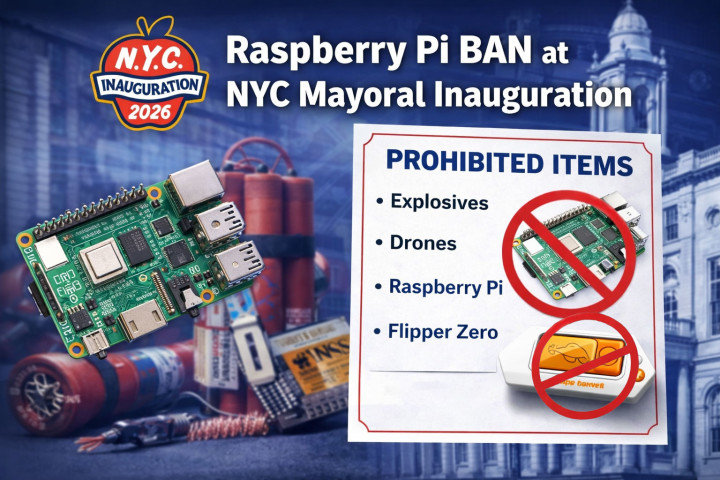
Somewhere in Lower Manhattan on January 1, a perfectly harmless single-board computer is apparently considered just one step removed from a pipe bomb. No word on whether they are referring solely to the full-sized Raspberry Pi computers or if the Raspberry Pi Pico is excluded as well. Can you bring a Raspberry Pi 500+?
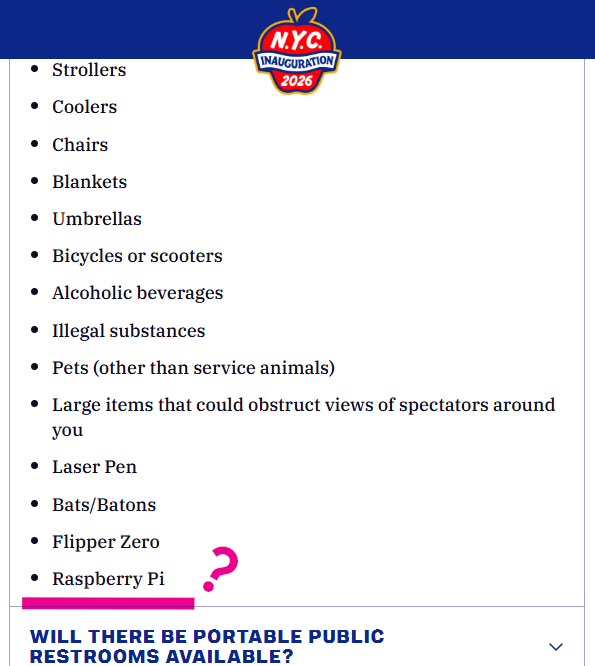
The Raspberry Pi appears under “What Shouldn’t I Bring?” on the inauguration website, helpfully grouped with the Flipper Zero, bats, batons, illegal substances, and umbrellas. Yes, umbrellas. New York does not mess around.
Raspberry Pi Ban Logic, Such As It Is
As we know here at Elektor, the Raspberry Pi is a small, general-purpose computer used mostly by students, educators, artists, journalists, and people who like blinking LEDs a bit too much. It has no special powers. It does not transmit mind control rays. It does not summon drones. It does not, on its own, hack traffic lights, reroute subways, or seize control of City Hall unless you already forgot to ban laptops, smartphones, and literally every other computer.
If the fear is electronic mischief, the policy is already in trouble. Every single person attending the event will be carrying a smartphone that is faster, more connected, more capable, and vastly harder to inspect than a Raspberry Pi taped to a power bank. The phone can livestream in 4 K, scan faces, emulate NFC tags, talk to cell towers, satellites, Wi-Fi, Bluetooth, and probably your fridge. The Pi, meanwhile, is still waiting for you to configure Wi-Fi properly.
When Security Lists Get Vibes-Based
New York normally writes excellent public safety rules. Times Square on New Year’s Eve — one of the most locked-down events on Earth — bans backpacks, drones, weapons, and alcohol. It does not ban brand names. It does not panic at the disco. It understands that crowd safety is mostly about physics, not gadgets.
The Raspberry Pi ban feels less like risk assessment and more like someone googled “hacker device,” recognized two product names, and stopped there. It is security by vibes. The list does the thinking so nobody else has to.
The Slippery Slope, Now With Microcontrollers
Once Raspberry Pi is out, the future is bleak. Arduino boards are next. ESP32 dev kits shortly after. SDR dongles, USB logic analyzers, DEFCON badges, graphing calculators held suspiciously sideways, Tamagotchis with custom firmware, a Game Boy with a link cable that “looks a bit RF-y”, and eventually a Furby that knows too much.
Meanwhile, everyone walks through security holding a smartphone capable of doing all of the above, plus ordering lunch.
Curiosity as Contraband
There is a cultural cost to banning devices such as Raspberry Pi by name. New York is full of educators, artists, accessibility hackers, and civic technologists who use small embedded computers as tools of expression and access. Turning those tools into suspicious objects does not make the event safer. It just makes the rules sillier.
Public safety works best when it is boring, precise, and unemotional. Clear categories. Clear risks. Clear enforcement. Not a gadget hit list parked next to explosives and hoping nobody notices.
The full prohibited items list, including the now-infamous Raspberry Pi, is available for your New Year’s Eve amusement here.
If nothing else, this may be the first time in history that the nerds have been scolded for bringing something too sus for the block party.


Discussion (5 comments)