As usual, the trade fair offered a wealth of new products to its visitors.
Every two years, the trade show Electronica takes place in Munich, Germany, bringing together leading businesses in the areas of electronics and semiconductors. However, due to Coivd restrictions, the last live event was in 2018. So, what has the industry been up to for the last four years? Stuart Cording chatted to some exhibitors to learn what they've been developing!
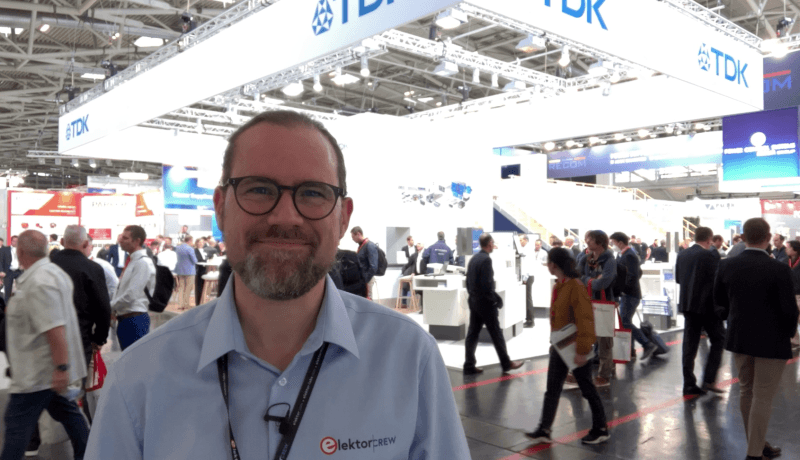
Spread across 14 halls the size of a DIY store and with over 2,100 exhibitors, Electronica is the largest trade show of its kind worldwide. Over 70,000 visitors come to explore what's new, many of whom travel from abroad. The show covers everything, from the semiconductor vendors and electronics suppliers to test and measurement and EDA tools. Although the show is on for four days, it is challenging to cover it all due to its size. However, I did my best, and if you'd like to see what I found, there is a new Elektor Engineering Insights video available on Elektor TV.
While electronics have had a role in private and commercial vehicles since the 1970s, the introduction of electric vehicles (EV) has promoted its importance significantly. Vehicles are increasingly becoming smartphones on wheels, with software being used to determine the car's functionality. Additionally, the automotive industry is struggling with the concept of rolling out software updates that can add functionality later in the vehicle's life or even fix known issues. Regardless of if their challenges, the semiconductor industry is already there, providing microcontrollers and power switches that provide exactly this capability.
Increasing EV range
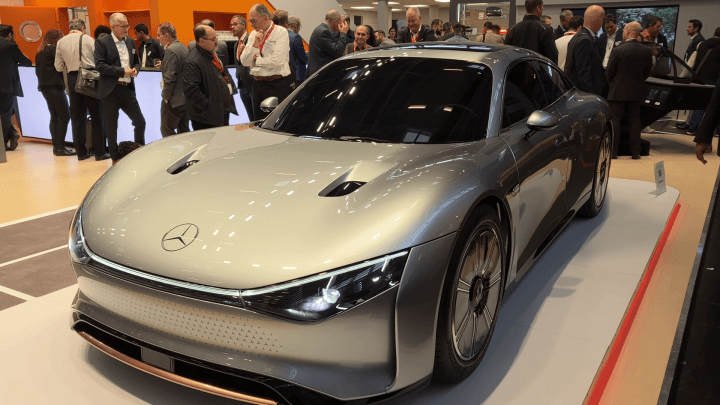
onsemi captured the crowds with the Mercedes-Benz all-electric VISION EQXX. This vehicle recently completed a 1,200 km journey from Stuttgart, Germany, to Silverstone, England, on a single charge. Wide bandgap silicon carbide (SiC) power devices, namely onsemi's VE-Trac modules, within the traction inverter are part of what makes this feat possible.
onsemi SiC technology is part of the Mercedes-Benz all-electric VISION EQXX traction inverter.
New MCUs for traction inverters
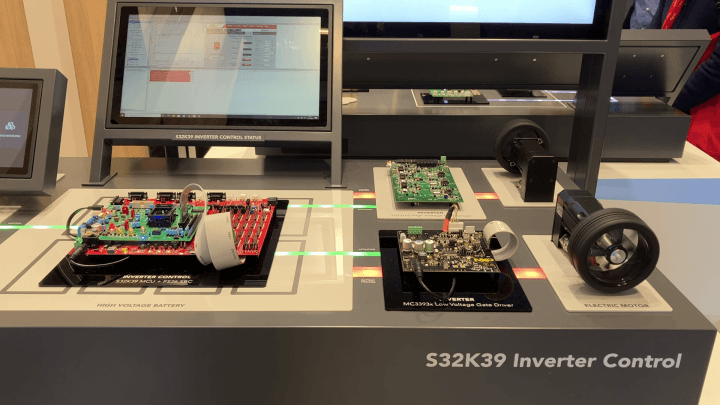
NXP is also fully invested in the software-defined vehicle and has been launching dedicated, powerful microcontrollers targeting this application. Their S32K39 was on display at this trade show, designed to penetrate the heart of traction inverters. Supporting up to two electric motors, and featuring all the necessary automotive connectivity and functionality, it could become a standardized platform for a complete series of vehicles. As algorithms improve over the vehicle's lifetime, the car's range and performance could end up being better for the third or fourth owner than it was for the first!
Thanks to its programmability, devices like the NXP S32K39 could lead to an electric vehicle delivering better motor performance to its fourth owner than experienced by the first.
Augmenting your reality...with lasers!
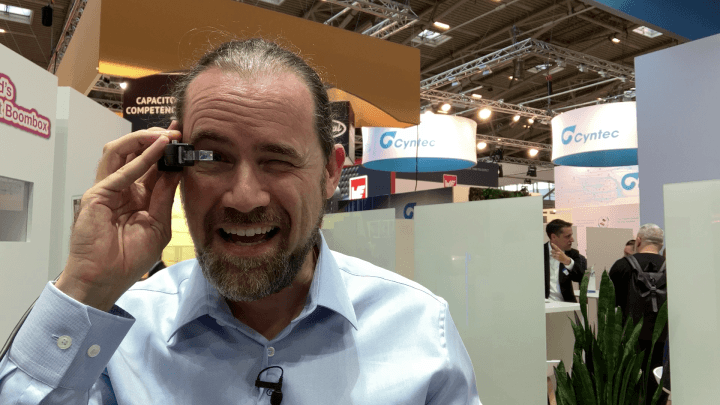
Obviously, there were many other exciting products and technologies on display, all of which you can review in the Elektor Engineering Insights video. However, one more product really stood out. TDK shared a prototype set of augmented reality glasses based on one of their laser modules. Outputting just a few milliwatts of power, the laser, together with a light guide, can project color images onto the retina of the wearer. Trying it out, it was very comfortable, with the image appearing sharp and clear. Although I could only test it for a few minutes, no discernable eyestrain was needed to see a sharp picture. TDK says they still need a couple more years to refine the laser module design, so perhaps we'll see a finished product at Electronica 2024.
No discernable eyestrain was required to get a clear image from these laser-based augmented reality glasses on display at TDK.
Overall, everyone I spoke to was happy to be back in the trade fair halls of Munich. The event has always been more than a trade show, with visitors meeting customers and suppliers, or catching up with old colleagues. So, if you couldn't attend, I hope you get a feel for both the technology on display and the atmosphere at this much-loved biennial event.



Discussion (0 comments)