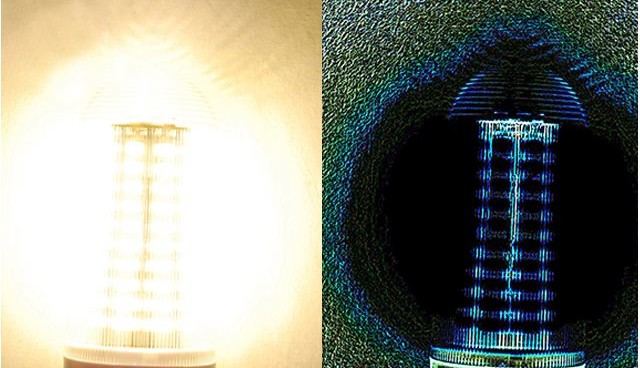
At right, details of the LED luminaire processed with the PST algorithm become visible
In very well-lit areas, our digital images are often overexposed, washed out with light, the details lost. Such loss of information is critical in image recognition techniques. The PST (Phase Stretch Transform) algorithm, developed at the University of California, considerably improves the processing of overexposed images. Happily, the code is open-source.
In very well-lit areas, our digital images are often overexposed, washed out with light, the details lost. Such loss of information is critical in image recognition techniques. The PST (Phase Stretch Transform) algorithm , developed at the university of California, considerably improves the processing of overexposed images and allows computers to distinguish details which are lost in standard images. PST is based on a proven Analog to Digital conversion technique for very wide band signals (

Elektor Magazine has been one of the leading sources of information on electronics for engineers, designers, start-ups and companies for 65 years. Our magazine is powered by an active community of electronics engineers – from students to professionals – who are passionate about designing and sharing innovative ideas.
For them, we publish hundreds of items a year, in formats such as articles, videos, webinars, and other learning formats. Our mission is to share knowledge in every possible way and inspire readers with the latest developments within the electrical engineering sector.