


Solar Power… revisited
October 3, 2015
on
on
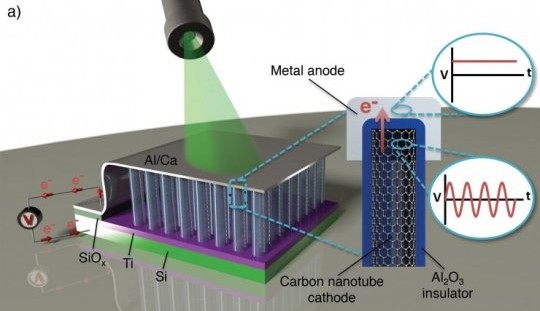
Solar cells traditionally use photovoltaic effects to convert sunlight to electrical energy but what if antennae could be made small enough to actually couple with light waves? Light is, after all, electro magnetic radiation, it’s just way up there in the spectrum somewhere between micro waves and ionising radiation. Enter the ‘optical rectenna’. It may sound like an instrument a doctor would use to check out the state of your colon but in fact it’s a nanometer-scale structure that functions as an antenna and rectifier diode, able to convert light directly into DC current.
Rectennae were originally developed in the 1960s and 1970s, operating at wavelengths down to ten microns. It’s taken until now for researchers at the Georgia Institute of Technology to make them small enough to couple with optical wavelengths and to fabricate tiny matching diodes able to operate fast enough to capture the electromagnetic wave oscillations.
In the new devices, developed by engineers at the Georgia Institute of Technology, carbon nanotubes act as antennae to capture light from the sun or other sources. As the waves of light hit the antennae, they create an oscillating charge that moves through rectifier devices attached to them. The rectifiers switch on and off at record high petahertz speeds, creating a small direct current.
Their efficiency remains below one percent but billions of rectennae in an array could produce significant current. The researchers anticipate that design optimization will further boost efficiency and believe that a rectenna with commercial potential may be available within a year.
Rectennae were originally developed in the 1960s and 1970s, operating at wavelengths down to ten microns. It’s taken until now for researchers at the Georgia Institute of Technology to make them small enough to couple with optical wavelengths and to fabricate tiny matching diodes able to operate fast enough to capture the electromagnetic wave oscillations.
In the new devices, developed by engineers at the Georgia Institute of Technology, carbon nanotubes act as antennae to capture light from the sun or other sources. As the waves of light hit the antennae, they create an oscillating charge that moves through rectifier devices attached to them. The rectifiers switch on and off at record high petahertz speeds, creating a small direct current.
Their efficiency remains below one percent but billions of rectennae in an array could produce significant current. The researchers anticipate that design optimization will further boost efficiency and believe that a rectenna with commercial potential may be available within a year.
Read full article
Hide full article
Discussion (1 comment)