


Superconductor based on graphene
January 31, 2017
on
on
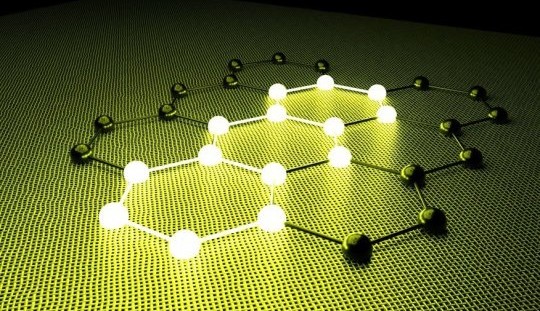
The intrinsic but 'dormant' characteristic of graphene to carry an electric current without resistance – superconductivity – was already known for some time, but recently researchers from the University of Cambridge have succeeded in actually activating this behavior. With this discovery, graphene, a material that already has the potential to radically change the electronics industry, has become even more interesting for countless applications.
Graphene consists of a two-dimensional layer of carbon atoms and has a number of remarkable characteristics. It is simultaneously light, flexible and very strong, and also conducts an electric current very well. That graphene could be a superconductor has been considered a possibility for some time – but until now this was only realized by attaching it to (another) superconducting material or doping it with one, a process that significantly worsens the other properties of graphene.
Researchers under the leadership of Dr. Angelo Di Bernardo and Dr. Jason Robinson have now managed to 'wake' the dormant superconductivity of graphene by combining it with a material that as called praseodymium cerium copper oxide (PCCO).
This discovery can, in due course, lead to the development of electronic circuits at a molecular scale with superconducting properties.
Graphene consists of a two-dimensional layer of carbon atoms and has a number of remarkable characteristics. It is simultaneously light, flexible and very strong, and also conducts an electric current very well. That graphene could be a superconductor has been considered a possibility for some time – but until now this was only realized by attaching it to (another) superconducting material or doping it with one, a process that significantly worsens the other properties of graphene.
Researchers under the leadership of Dr. Angelo Di Bernardo and Dr. Jason Robinson have now managed to 'wake' the dormant superconductivity of graphene by combining it with a material that as called praseodymium cerium copper oxide (PCCO).
This discovery can, in due course, lead to the development of electronic circuits at a molecular scale with superconducting properties.
Read full article
Hide full article
Discussion (1 comment)