All sorts of kits for the development of IoT and connected applications exist, and all aim at making the life of the developer easier. However, an easy life for the developer is one thing, it should not be the goal. The end user of the application likes simple things too. The Arduino Primo tackles this problem by combining a powerful Wi-Fi-enabled access point with satellite boards that communicate with the AP over Bluetooth. Throwing in NFC brings “tap-to-connect” to the mix.
All sorts of kits for the development of IoT and connected applications exist, and all aim at making the life of the developer easier. However, an easy life for the developer is one thing, it should not be the goal. The end user of the application likes simple things too. The Arduino Primo tackles this problem by combining a powerful Wi-Fi-enabled access point with satellite boards that communicate with the AP over Bluetooth. Throwing in NFC brings “tap-to-connect” to the mix.
Placing the Arduino Primo in its context
The Arduino Primo — co-developed by Arduino, Nordic and Dog Hunter — has its origins at Arduino.org, from the dark ages of Arduino when two groups were fighting each other. Because of this, the Primo is not listed on the Arduino website’s ‘Products’ page although it is available from its store.
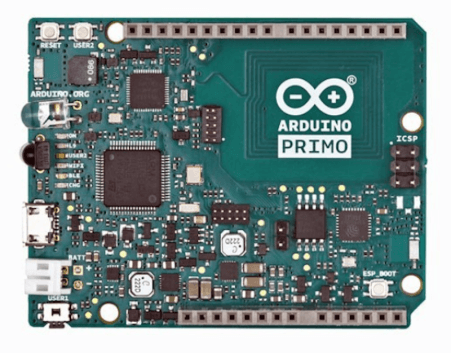
Arduino Primo - the large IC is not the main MCU.
Arduino Primo's features & peripherals
The Arduino Primo combines a Nordic nRF52 32-bit ARM processor with integrated NFC and Bluetooth Low Energy a.k.a. Bluetooth Smart, an Espressif ESP8266 Wi-Fi chip, and an infrared receiver and transmitter. Of course, there are also (tiny) pushbuttons and LEDs, a buzzer, and even a battery charger.
Looking at the Primo one immediately notes the big 64-pin IC close to the micro USB connector. Surprisingly, this is not the main processor, but the programmer/debugger MCU. The nRF52 is tucked away in a corner of the board. Actually, the Primo has three microcontrollers (MCUs) to play with:
Nordic nRF52832, the main MCU with integrated BLE and NFC;
STMicroelectronics STM32f103, used for advanced debugging and programming of the other MCUs;
Espressif ESP8266, for Wi-Fi.
The large USB-B connector of the Arduino Uno is replaced by an infrared LED and an IR receiver. A micro USB-B connector next to it provides the USB interface. The traditional power jack has been replaced by a battery connector.
The Arduino Primo Core module
A stripped-down 33-mm circular version of the Primo is available under the name of Primo Core. It only has the nRF52832 MCU but adds a gyroscope, accelerometer, and a temperature and humidity sensor. Powered from a coin cell this little board is intended as an IoT node, wearable or not, that delivers its data to the big Primo with its Wi-Fi internet connection. The NFC antenna is printed on a second board to be plugged onto the core board.
The Primo Core board does not have an on-board programmer and relies on the Primo's programmer MCU. J-Link type pods can be used too.



Discussion (0 comments)