


Review: The Velleman CS400 Metal Detector
Out in the field
On my experience: In the above video you can see me, near where I live, exploring the foundations of castle Höhingen which was destroyed in the Thirty Years' War. From here there is a fantastic view across the Rhine Valley and the area may also provide a good opportunity to uncover some ancient buried artifacts — you never know…
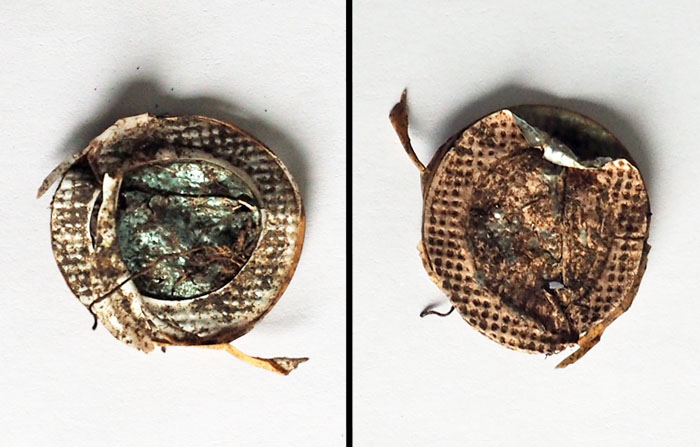
Before long, a series of bleeps indicated something non-ferrous buried beneath my feet. Unfortunately it turned out to be a thin aluminum foil and plastic sealing disk from a soda or screw-top wine bottle, probably carelessly discarded during a medieval banquet back in the 1600’s; the emperor’s troops did a lot of pillaging back then and were well known for being untidy litter bugs…
Conclusions
On a more serious note, it’s important to be aware of and comply with all the regulations governing the use of metal detectors before you even begin to set out detecting.The detector is really sensitive and armed with the CS400 you would be pretty well equipped to detect a wide range of buried artifacts, not only those just laying on the surface. Just how sensitive and selective the unit is, can be seen from the following example:
Above my apartment is a loft space and my ceiling is supported on a series of wooden joists, with a layer of wooden boards fixed to their underside supporting light aerocrete concrete blocks filling in the gaps between the joists. Some years ago I wanted to screw a TV mount to the ceiling and found it quite difficult to locate the positions of the load-bearing wooden joists above the layer of plasterboard and wooden planks. I bought a DIY cable / stud finder at the local hardware store so I could work out from below where to put the screws but it proved useless. I thought this might be a good test for the CS400 to see how well it was able to discriminate between the different materials used in the ceiling’s construction. I was surprised how well it was able to locate the positions of the 15 cm thick wooden joists. The metallic salts in the lightweight aggregate concrete blocks between them could be detected through the (2.5 cm thick) layer of wooden planks and 1 cm layer of plasterboard. That was quite impressive.
Read full article
Hide full article
Discussion (0 comments)