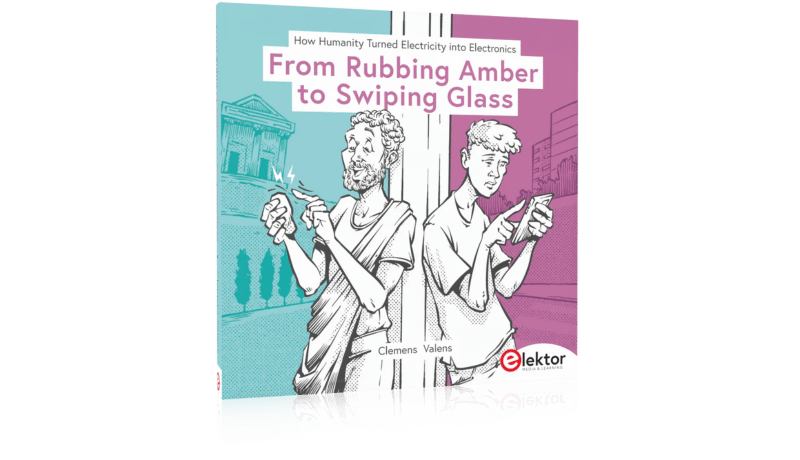
Book Review: From Rubbing Amber to Swiping Glass – How Humanity Turned Electricity into Electronics by Clemens Valens
"From Rubbing Amber to Swiping Glass – How Humanity Turned Electricity into Electronics" is a truly special book, especially considering that it's about technology and electronics. It's not a step-by-step guide for building electronic circuits, nor is it a history of electronics or a reference work for technical experts. So, what is it? Günter Spanner took a closer look.
Is it a step-by-step guide for building electronic circuits? No.
Is it a book about the history of electronics? Not quite.
Is it a reference work for technical experts? Also, no.
What this book offers is a curious and captivating journey through the fascinating development of electronics.
The book offers a compact, narrative journey through the colourful history of electricity and electronics, from the earliest observations of static effects of rubbed amber to the modern interaction with touchscreens by swiping glass.
Not only does it give fascinating insights into the discovery of the electron but also engaging stories, such as that of the flying boy used to demonstrate the properties of electric charge. Readers learn how Leyden jars work and even how to build one themselves. The book also includes several hands-on experiments, such as constructing a simple voltaic cell. From Rubbing Amber to Swiping Glass combines technical background with interesting facts and anecdotes.
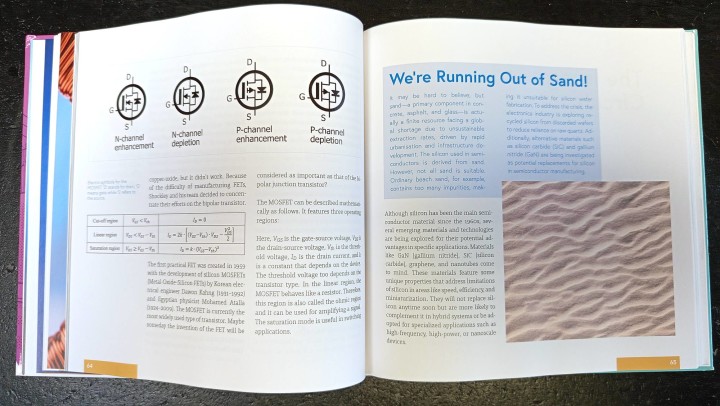
Important formulas and laws like Ohm’s law, Kirchhoff’s rules or the Maxwell equationsare introduced in a historically accurate yet entertaining way. Passive components are far from neglected: their discovery, use, and applications are explained with vivid anecdotes and memorable examples.
But the story doesn't stop in the early days of electronics. Later chapters explore the development and use of the operational amplifier, the basics of semiconductors, and the function of components like LEDs and transistors. Also advanced technologies such as microcontrollers and modern data systems are discussed. Even such questions of why most modern circuit boards are green are answered in detail.
Finally, the book ends with a glimpse into the future of electronics—both near and far. Altogether, From Rubbing Amber to Swiping Glass – How Humanity Turned Electricity into Electronicsis a unique blend of history, science, and storytelling that invites curious minds on a delightful journey through the world of electronics.
Style and Design
This book isn’t your typical dry science chronicle. It’s a story-driven adventure through the electrifying development of electricity and electronics. Instead of endless timelines and formulas, you’ll find surprising connections between brilliant inventors, curious discoveries, and world-changing technologies.
Think less of a textbook, but more of a collection of "Aha!" moments. Many pages are brought to life with full-color illustrations that make even 200-year-old lab gear feel fresh and exciting.
The tone? Smart, but never stuffy—like a knowledgeable friend who also happens to be a great storyteller. And with 163 neatly packed pages, the book offers a broad overview rather than deep scientific dives, making it perfect for anyone who's curious about how sparks turned into circuits, and how humanity went from rubbing amber to swiping glass…
Strengths
Compact overview of the major developments in electronics: From ancient Greek ideas about static electricity to today’s everyday electronics, the book traces the big picture in a concise and engaging way.
Visually appealing: High-quality illustrations make it easier to understand even more complex developments.
Reader-friendly style: Written in an accessible and engaging tone, it's ideal for a broad audience with general curiosity, no prior technical knowledge required.
Limitations (if any)
The book offers a broad, accessible overview rather than an in-depth technical analysis, making it a perfect starting point for curious readers, though highly specialized audiences may find it more of an engaging refresher than a real deep dive into technology.
Who is it for?
Reader Profile
Recommendation
Fans of technology and science history
Highly recommended
Beginners with no prior knowledge
Informative and easy to read
Professionals / Electronics experts
An excellent supplement
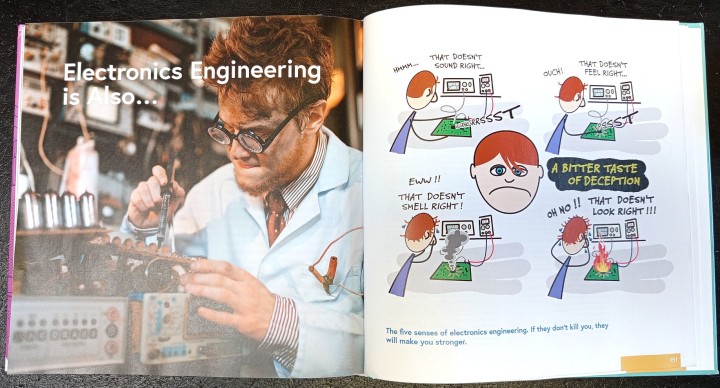
All in all, this book is especially valuable for teachers and educators. It offers many anecdotes, interesting side stories, and background information on the discovery and development of electronic components and circuits, which can be effectively integrated into teaching materials and classroom lessons. The five senses of electronics engineering. If they don't kill you, they will make you stronger.
Conclusion
With From Rubbing Amber to Swiping Glass, Clemens Valens offers an engaging and visually appealing introduction to electricity and its transformation into modern electronics. Given its concise length, the book emphasizes a broad overview rather than in-depth technical analysis—readers seeking detailed insights may want to consult more specialized literature. However, for anyone interested in a narrative-driven, accessible journey from early experiments with static electricity to today’s touchscreen technology, this book is an excellent place to begin.





Discussion (0 comments)