


Vintage Radio Equipment by Giovanni Becattini
August 5, 2025
on
on
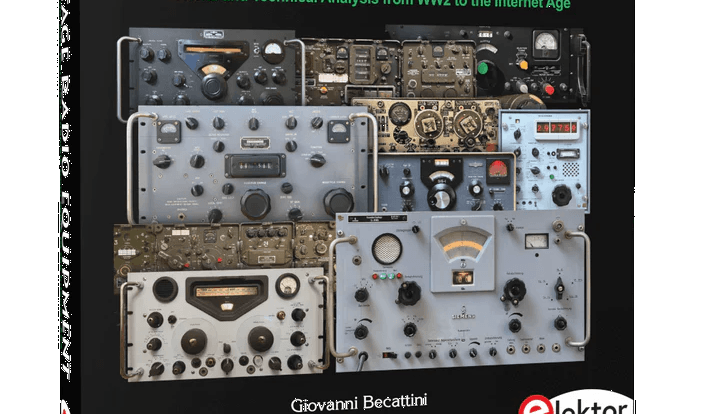
Professional receivers and transmitters from 1940 to 1970—tube-based technology for the military, aviation, and maritime sectors — are presented in the book Vintage Radio Equipment with stunning images and outstanding explanations. Author Gianni Becattini is an electronics engineer and collector of such equipment. He also details the restoration of individual receivers with great care.
As a teenager, I was able to buy some components pulled from military radio equipment at Radio Fern in Essen, Germany — mostly crystals and headphones. Later, I also came across some tubes that had previously been used in military gear.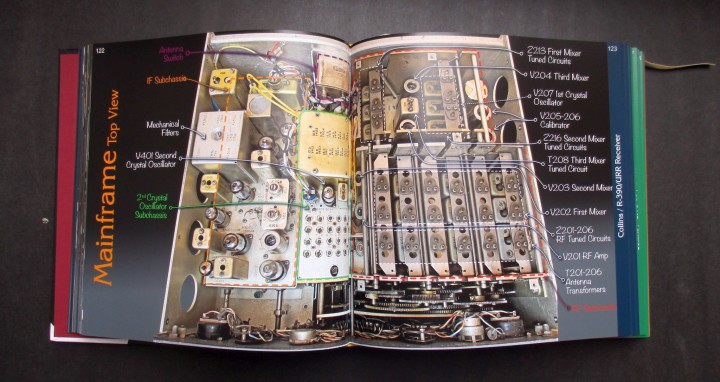
Early Encounters with Radio Technology
Many years ago, I learned about radio technology mostly from discarded tube radios and more modern amateur radio equipment. I built my first shortwave receivers from the parts of junked radios, using commercial radio gear as inspiration. Back then, I had already read about surplus equipment and how many people used or modified it for amateur radio purposes. But I had never seen such devices from the inside. That makes it all the more exciting to now learn about the details.As a teenager, I was able to buy some components pulled from military radio equipment at Radio Fern in Essen, Germany — mostly crystals and headphones. Later, I also came across some tubes that had previously been used in military gear.
Discovering Hidden Engineering Marvels
I had heard of mechanical IF (intermediate frequency) filters and their excellent steep skirts, but now I finally know what they looked like. However, the PTO (Permeability Tuned Oscillator) was completely new to me. It employs a ferrite core moved in and out of the oscillator coil via a threaded rod. For example, the tuning knob could make 10 full turns, and tuning was absolutely linear over a megahertz range — allowing for frequency settings more precise than 1 kHz. That level of accuracy was important to ensure these radios could cover the entire shortwave spectrum with good stability.Collins and the Rise of Amateur Radio Gear
One of the book's main elements focused are the military receivers from Collins. But the Collins S-Line also makes an appearance, and I saw it in use during my amateur radio training. In that series, the receiver, transmitter, and power supply with loudspeaker were all separate units. At the time, the S-Line was considered the gold standard in amateur radio — and it even included mechanical filters. In fact, military technology likely helped push amateur radio forward.Filtering Technology: Collins vs. Siemens
The quality of the IF filters was extremely important. Collins relied on mechanical filters, while Siemens took a completely different approach at the time. In a triple-conversion superheterodyne receiver, the lowest IF was set to 30 kHz. For SSB and CW, Siemens used coils and capacitors to implement the filters. In the magnificent photos in the book, I was able to recognize some of the parts — several of which are still in my spare parts box: Siemens pot cores and polystyrene capacitors. It’s hard to believe what was already possible back then. Compared to that, we have a far easier job today — since in an SDR (Software Defined Radio), filter characteristics are defined entirely by software.A Passionate Tribute to Radio History
Gianni Becattini writes vividly and engagingly about his passion for vintage radio technology — about the equipment he personally owned, how it was restored, how it was operated, and what its reception capabilities were. His love of detail is one of the book’s greatest strengths. Add to that the outstanding photographs, and you have a compelling package. Once I opened Vintage Radio Equipment, I couldn’t put it down. Nearly 600 pages packed with fascinating technology. It's incredible how much work and energy went into the development of radio technology. Subscribe
Tag alert: Subscribe to the tag radio and you will receive an e-mail as soon as a new item about it is published on our website! Read full article
Hide full article

Discussion (0 comments)