


New current sensors have no magnetic circuits
May 22, 2017
on
on
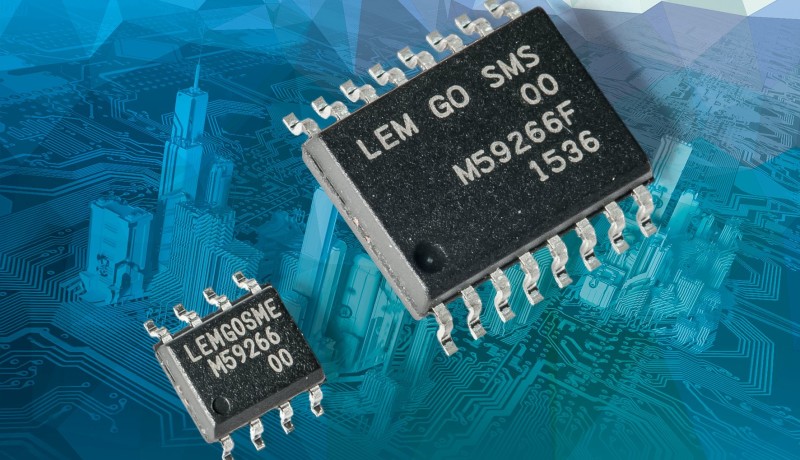
Here are some new integrated circuit transducers for AC and DC isolated current measurement up to 300 KHz that offer full isolation, despite their small size, by integrating the primary conductor for nominal current measurements of up to 30 A. The transducers are mounted directly onto a printed circuit board as SO8 or SO16 SMT devices and support overload currents up to 200 A peak for short durations (1 ms).
LEM’s GO series offers several types covering a range from 4 to 30 amperes with a measurement span of 2.5 times the nominal current. Standard models provide an analogue voltage output with different sensitivity levels according to the models to achieve an output voltage of 800 mV @ IPN for 5V versions and 500 mV @ IPN for 3.3V versions. Ratiometric output is available on some models.
The new transducers do not use the Hall effect, but instead integrate conductors for gradient measurement to provide an immunity against the external fields found in power electronic applications. The absence of a magnetic circuit means that there is zero magnetic offset generated, improving their accuracy.
Photo: LEM
LEM’s GO series offers several types covering a range from 4 to 30 amperes with a measurement span of 2.5 times the nominal current. Standard models provide an analogue voltage output with different sensitivity levels according to the models to achieve an output voltage of 800 mV @ IPN for 5V versions and 500 mV @ IPN for 3.3V versions. Ratiometric output is available on some models.
The new transducers do not use the Hall effect, but instead integrate conductors for gradient measurement to provide an immunity against the external fields found in power electronic applications. The absence of a magnetic circuit means that there is zero magnetic offset generated, improving their accuracy.
Photo: LEM
Read full article
Hide full article
Discussion (0 comments)