


Real time water-borne bacteria detection
October 12, 2015
on
on
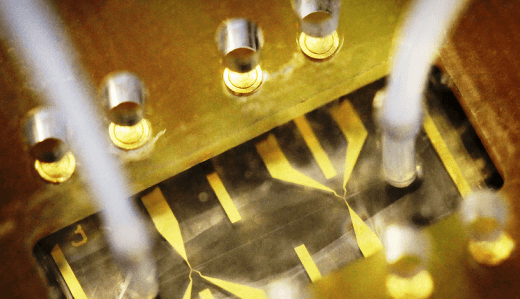
Testing water quality is normally a time consuming process but a new technique developed by SBT Aqua can perform online, real-time measurements of bacteria levels in aqueous solutions with no pretreatment of the sample, no incubation time, and no manual sample handling. It uses impedance flow cytometry where impedance measurements detect particles and bacterium on a single cell basis.
A liquid sample continuously passes along a microfluidic channel with integrated electrodes over which a multi-frequency voltage signal is applied. Bacteria and particles transition across the electrodes and produce a change in impedance. The impedance change for bacteria is uniquely different compared to other non-organic particles, making it possible to provide a very accurate estimate of both the bacteria and particle count in the sample in real-time.
A number of sensors would typically be installed throughout the water distribution network to provide continuous data rather than the sporadic monitoring at single sample points, which is the norm today.
The system is currently undergoing trials in Denmark.
A liquid sample continuously passes along a microfluidic channel with integrated electrodes over which a multi-frequency voltage signal is applied. Bacteria and particles transition across the electrodes and produce a change in impedance. The impedance change for bacteria is uniquely different compared to other non-organic particles, making it possible to provide a very accurate estimate of both the bacteria and particle count in the sample in real-time.
A number of sensors would typically be installed throughout the water distribution network to provide continuous data rather than the sporadic monitoring at single sample points, which is the norm today.
The system is currently undergoing trials in Denmark.
Read full article
Hide full article
Discussion (0 comments)