The judging panel of the STM32 Edge AI Contest selected three exceptional projects that demonstrated outstanding technical quality, practical functionality, and thoughtful innovation. Congratulations to the winners!
STMicroelectronics and Elektor once again joined forces to launch the STM32 Edge AI Contest. The objective was simple: use STM32N6 Discovery Kit creatively to solve real engineering challenges. The community responded enthusiastically. Dozens of participants worked over the past months to design, test, and refine their ideas, from computer-vision tools to predictive maintenance and environmental monitoring.
This year’s entries stood out not only for technical depth, but also for working prototypes and clear system design. After a rigorous evaluation process, the judging panel selected three exceptional projects that demonstrated outstanding technical quality, practical functionality, and thoughtful innovation. The three winning projects were announced during a live online event on Thursday, October 27, 2025. You can watch the ceremony here:
The Winning Projects
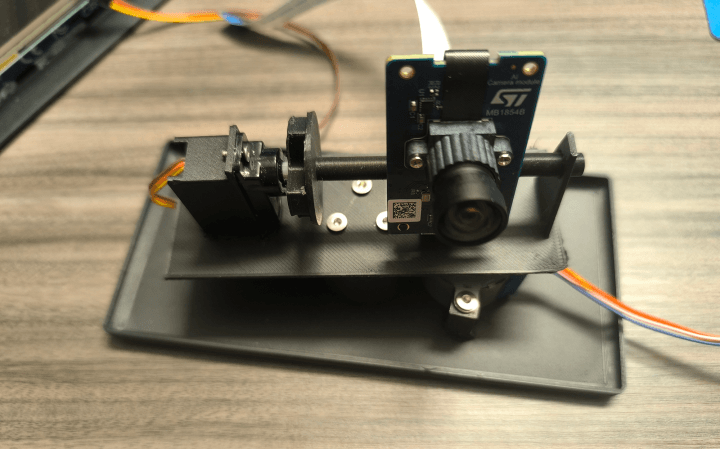
Claiming the prestigious First Prize (€2,500) is Stefan Nikolaj, with his EasyGimbalproject — an AI-powered camera gimbal built around the STM32N6570-DK development board. Designed to solve the challenge of filming oneself without a dedicated camera operator, EasyGimbal uses on-board pose estimation to track a subject smoothly across both horizontal and vertical axes. Stefan combined accessible off-the-shelf mechanics, custom 3D-printed gearing, and a carefully engineered motor-isolation board with a well-structured firmware stack based on ST’s MoveNet example. The result is an impressively documented, creator-friendly, automated cameraman that brings professional-style tracking shots within reach of anyone. A truly deserving victory — congratulations, Stefan! EasyGimbal - STM32N6 Smart Camera
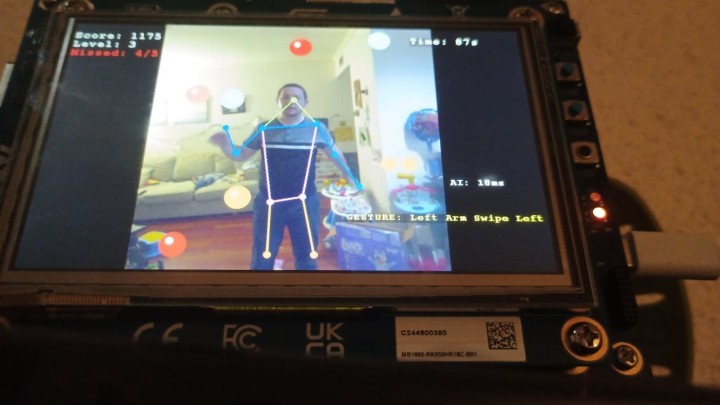
Winning the Second Prize (€1,500) is Ninja Fruit by Antonio Mendoza Gonzales - an energetic, gesture-controlled game that turns the STM32N6570 Discovery Kit into an interactive playground for edge AI. Inspired by playful bubble-popping games and designed to showcase the impressive real-time inference capabilities of the STM32N6, this project uses the MoveNet pose-estimation model to track wrist, arm, and nose movements for slicing fruits or popping bubbles on the LCD. Featuring multiple game modes, special gesture-activated effects, increasing difficulty levels, and cleanly structured firmware built on ST’s pose-estimation demo, the project demonstrates a fun yet powerful example of what fast, on-device AI can achieve. Highly engaging, technically well executed, and perfect for trade show demos — well done, Antonio! Ninja fruit with STM32N6
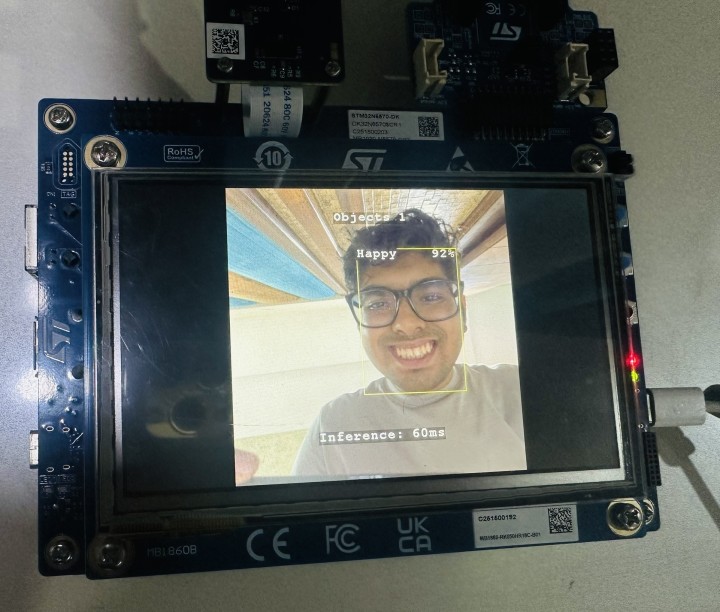
Earning the Third Prize (€1,000) is NeuroSense by Girish Arora, Kartik Khandelwal and Viren Sharma. NeuroSense is a Real-Time Mental Health Monitoring System, an ambitious multimodal edge-AI platform designed to bring continuous emotional well-being assessment to everyday life. Built around the STM32N6570-DK and its integrated NPU, NeuroSense fuses facial emotion recognition, speech cues, and EEG biosignals into a unified mental-state inference system, all running in real time on-device. The team designed a complete signal-acquisition chain with instrumentation-grade EEG amplification and filtering, paired with a Yolov8-based emotion model and a TouchGFX touchscreen interface that presents users with instant feedback, mood tracking, and stress indicators. A highly innovative application of edge AI to an underserved field, NeuroSense shows both strong engineering execution and commendable societal impact potential. A thoughtful and forward-looking project — congratulations to the team behind NeuroSense! NeuroSense – Real-Time Mental Health Monitoring System on STM32N6
Are you inspired?
Elektor and STMicroelectronics would like to congratulate the three winners and thank all participants for submitting their projects. Are you inspired? As you develop your own STM32-based projects, we encourage you to share your innovations with the global electronics community. You are welcome to post your projects on the Elektor Labs online platform.



Discussion (0 comments)