


Zero-drift opamp draws 1.3 μA at 1.8 V
August 21, 2017
on
on
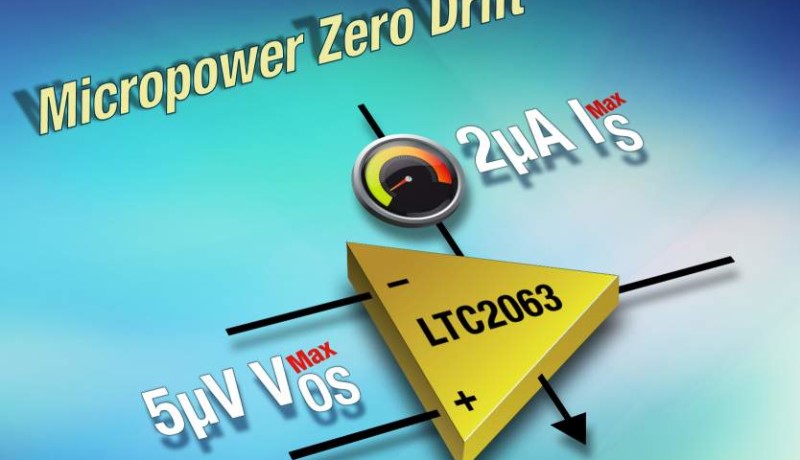
A new zero-drift opamp has been announced that draws just 1.3 μA on a 1.8 V supply and features a maximum input bias current of 15 pA a maximum input offset voltage of 5 μV at 25°C. Even though these values increase slightly over the full temperature range from –40 °C to 125 °C, they do allow the use of large value feedback network resistors, keeping power consumption low even at high temperatures.
The new LTC2063 from Analog Devices has rail-to-rail inputs and outputs (RRIO) and is available in SOT-23 and SC70 packages. The 6-lead SC70 version also includes a shutdown mode which reduces current consumption to as little as 90 nA when the amplifier is not in use, enabling ultralow power duty cycled sensor applications.
An integrated EMI filter provides 114 dB electromagnetic interference rejection at 1.8 GHz. With low 1/f noise inherent to its zero-drift architecture, the device is well suited for amplifying and conditioning low frequency sensor signals in portable and wireless sensor network applications.
Illustration: Analog Devices
The new LTC2063 from Analog Devices has rail-to-rail inputs and outputs (RRIO) and is available in SOT-23 and SC70 packages. The 6-lead SC70 version also includes a shutdown mode which reduces current consumption to as little as 90 nA when the amplifier is not in use, enabling ultralow power duty cycled sensor applications.
An integrated EMI filter provides 114 dB electromagnetic interference rejection at 1.8 GHz. With low 1/f noise inherent to its zero-drift architecture, the device is well suited for amplifying and conditioning low frequency sensor signals in portable and wireless sensor network applications.
Illustration: Analog Devices
Read full article
Hide full article
Discussion (0 comments)