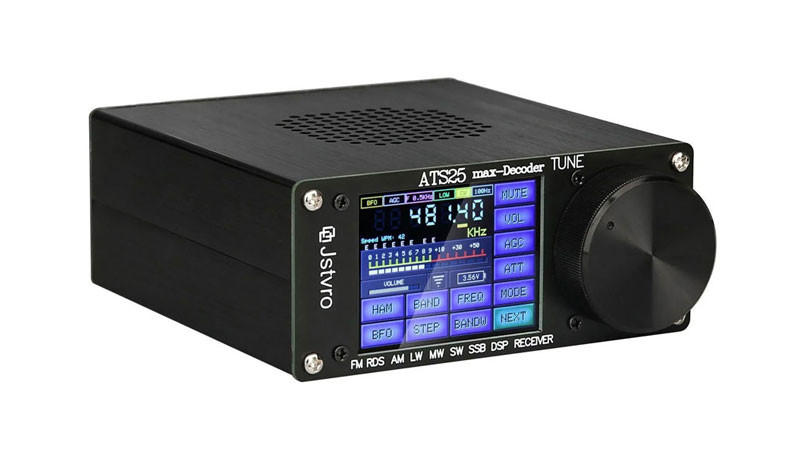
73, all hams and radio fans! Once again, Elektor presents a pronounced combination of embedded and radio technology in the form of the ATS25 max-Decoder — a powerful, ultra-compact multimode LW/SW/MW/FM/Ham band DSP receiver powered by an ESP32 core and with Wi-Fi connectivity for advanced decoding modes.
73, all hams and radio fans! Once again, Elektor presents a pronounced combination of embedded and radio technology in the form of the ATS25 max-Decoder — a powerful, ultra-compact multimode LW/SW/MW/FM/Ham band DSP receiver powered by an ESP32 core and with Wi-Fi connectivity for advanced decoding modes.
Radio in general and ham radio in particular have been pioneering, challenging and rewarding fields of application for fans of microcontrollers, programming, and small embedded systems. This is mostly due to the arrival, not so long ago, of ICs and drop-in integrated modules that take care of all the high-frequency signal conditioning and then offer a set of pins responsive to digital levels for the control and even for outputting digital levels. What more can a programmer want?
Embedded — with a Radio Attached
One IC family that’s been highly successful in encouraging even the staunchest supporters of all-analog RF technology to embrace (or at least accept) “digital”, is the SkyWorks Si473x series. Of these, the Si4735 is a “CMOS 100% AM/FM/SW/LW radio receiver”, meaning it integrates the complete tuner function from antenna input to audio output. Although the chip went viral among hams and other radio lovers when Arduino software appeared for it, its superb performance wasn’t fully exhausted until an international group of hams and programmers grabbed a slightly more powerful microcontroller called ESP32 and started to write ingenious software, not just for the LW/MW/SW/FM broadcast bands but also for the radio amateur bands from 160 m through 10 m and the associated “ham modes” like CW, RTTY, USB/LSB, FAX, and others.
The Si4735 chip and the ESP32 micro first showed up jointly in the “ATS25” multimode receiver, which has been around for a few years now, performing well as a general-purpose radio for listening to broadcasts and ham communications. Recently, however, the “Jstvro” group added a bunch of options, advanced digital decoding, Wi-Fi, and more intelligent DSP audio processing to the standard ATS25, which in fact got a complete makeover in terms of control software.
Subscribe
Tag alert: Subscribe to the tag Wireless & Communication and you will receive an e-mail as soon as a new item about it is published on our website!
Can’t Believe It’s So Small
The first thing that struck me when unboxing my review copy of the ATS25 max-Decoder was its compactness, sturdiness, light weight, and the presence of just one control on the front panel: a 40 mm diameter knob with the immediate feel of a rotary encoder with push-button action. On the back of the radio are two antenna inputs — one SMA socket for the Wi-Fi (2.4 GHz) antenna and one BNC socket for the antenna. There’s also a USB-C connector, which doubles for charging the internal Li-Ion battery and for communication with your PC. A headphones socket and two minute slide switches complete “user interface” on the back panel.
I was pleasantly surprised by the inclusion in the package of a stylus pen, a foldable Wi-Fi antenna, a telescopic rod antenna for FM, a USB-C cable, and even a cloth which I guess is for dust protection or for cleaning the touch screen. Apart from the radio of course, the best find in the box was the ATX25 max-Decoder Manual which, although not perfect, is a league above the usual grot you get with Chinese electronics. The 24-page manual is properly printed, has clear pictures with legends and captions to show the most important functions, and is really worth browsing with the radio off! I was informed that Elektor considers enhancing the manual and printing their own version.
Antenna First — Always
All microcontroller fans must remember this: it’s not bits and bytes, but a proper antenna that’s your radio’s best friend. The included telescopic antenna is great for FM band reception when fully extended, but if you use it on LW/MW/SW or ham bands, you will be disappointed. Instead, roll out at least 10 meters of flexible wire, string it up outdoors and simply clip the free end to the telescopic antenna. Then the fun begins, unless…. as in my case, there’s massive interference from (digital) sources like LED lights, computers, smartphones, and my 7.5 kWp solar panel installation, in particular, the SolarEdge 3-phase inverter. So I switched that off and got rid of 180-kHz spaced harmonics and spurious signals extending to well over 60 MHz. The ATS25’s internal noise is present but manageable, as I found by silencing the antenna input with a 50-ohm terminator. The remaining noise is burst-like from operating the rotary encoder, and from the OLED screen.
Due to radio wave propagation, daytime reception in the MW and LW bands is poor even if you have a wire antenna. However, the ATX25 max-Decoder was able to find several stations around 675 kHz and 1000 kHz and turned out to work just as well as my Grundig Yacht-Boy and even a 1960’s Philips “BX” tube radio, both using ferrite rod antennas. I also found good old Droitwich on 198 kHz LW with a BBC cricket match report. The MW band in particular comes alive in the evening hours and is great fun to tune across to find pirate and “low-power” stations for private use.
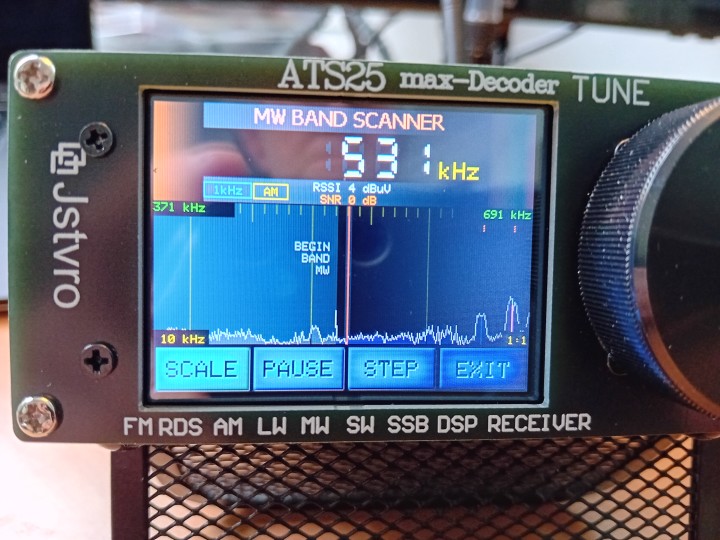
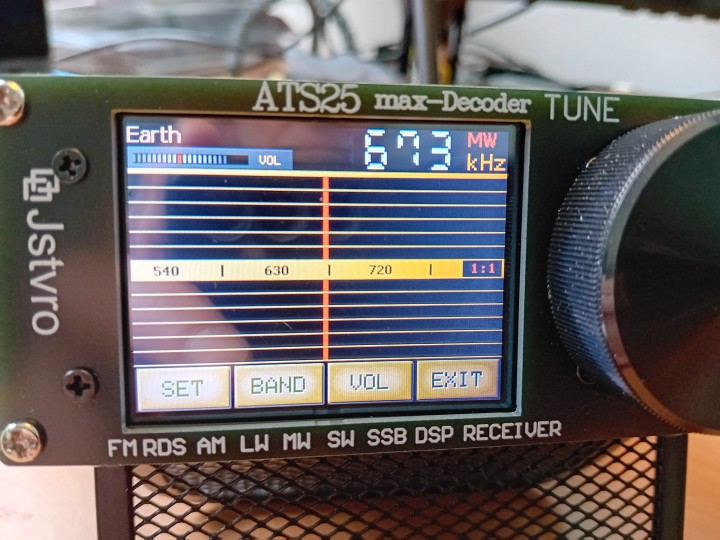
Scanning the MW band for activity using the built-in spectrum analyzer. Not a lot to hear at daytime but come again near dusk and the party starts.
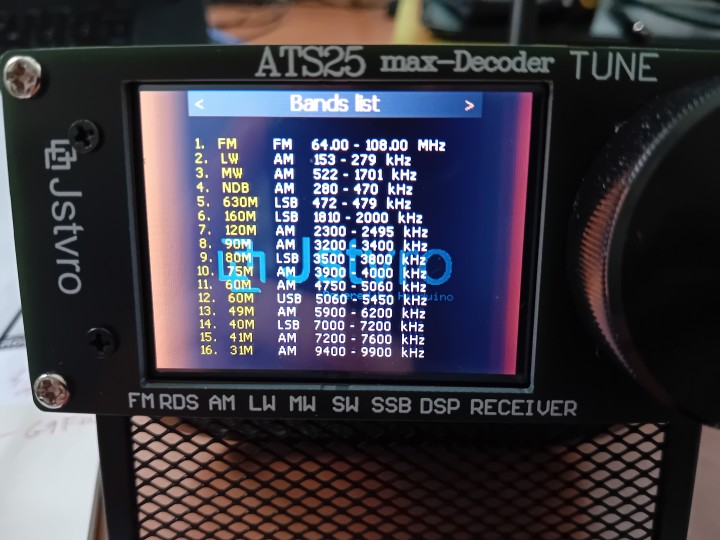
On my ATX25 max-Decoder, the FM band extends from 64 to 108 MHz, which I haven’t seen before and allows me to at least monitor the 4-meter (70 MHz) band, which is not available under the “HAM” bands. It also picked up some 80 MHz police radio traffic from just across the border in Germany.
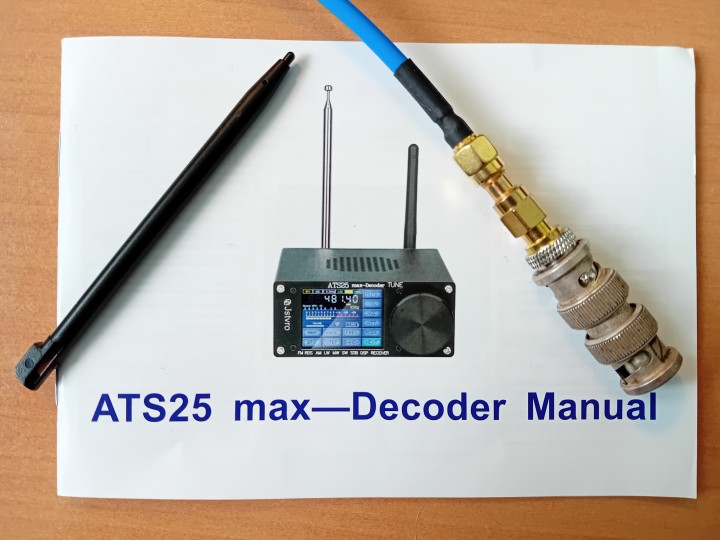
I eventually changed the antenna for a wire loop, which responds to magnetic fields instead of electric fields, as does the plain wire antenna. However, the small loop antenna available from Elektor is terminated in an SMA connector while the ATS25 receiver has BNC socket. So I slapped up an adapter by cascading an SMA-to-BNC adapter and a BNC male-to-male adapter. This worked well and reduced man-made noise massively, thanks to the loop being directive so it can be tuned to eliminate noise sources like LED lamps, LCD screens, etc.
My makeshift SMA-to-BNC adapter (in two steps but 50 ohms throughout), the indispensable stylus (left) and the printed manual.
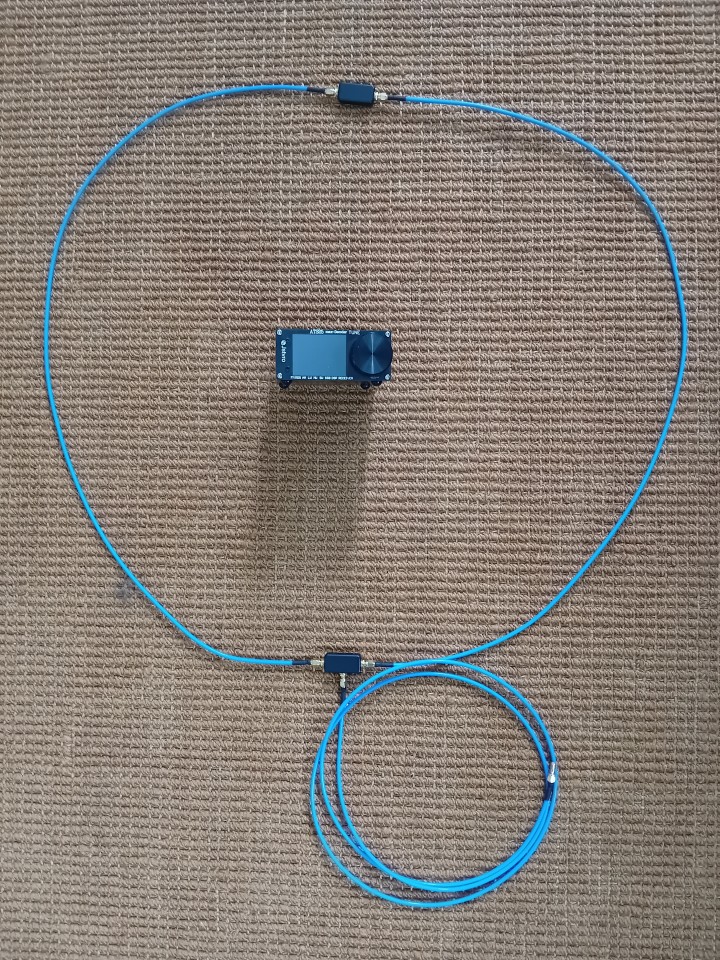
It’s best to hang up the loop antenna outdoors, as far away from noise sources, and feed the cable inside to your receiver.
The "YouLoop" from the Elektor Store is a good starting point for a proper antenna. Remember though that it's not really suitable for permanent outdoor use. Also, there should be nothing inside the loop :-)
Welcome to Radio
Once you know some of the quirks of radio wave propagation, the tuning and listening experience from the ATS25 max-Decoder is level with many “big box” receivers. I found that operating the ATS25 with the supplied stylus requires getting used to and initially I mislaid my stylus and was forced to select some of the ultra-small fields and icons on the touch screen with my fingertip, but that too worked. Another slight problem was keeping the radio steady and positioned at a slight angle with the rather stiff (semi-rigid) coax cable from the loop antenna connected at the back. I solved this by placing the radio on a smartphone holder. Yes, I am used to SW receivers weighing 20 kgs and up (Collins, Hallicrafters, you know).
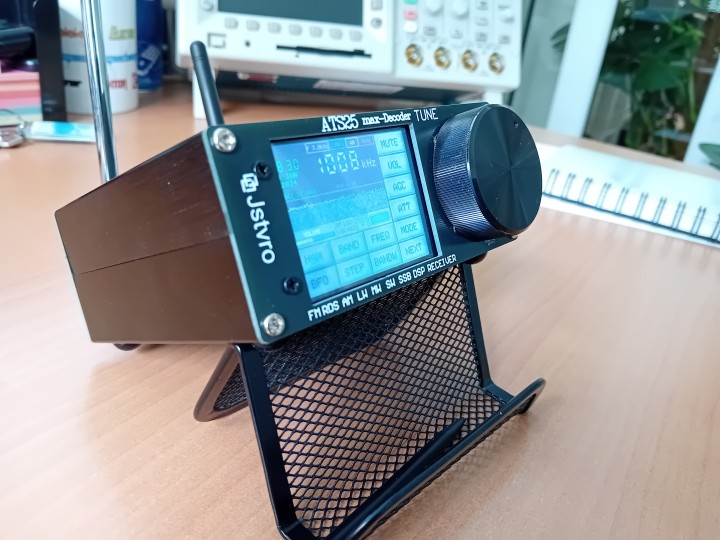
I used a cheap smartphone holder to secure the receiver at a comfortable angle for viewing and operating. The stylus also has its place.
I was able to listen in on many local QSOs on 80-meters SSB (3.5 MHz), which is really a “chat” band with daytime distances of up to 300 kms between stations. On 20 meters (14 MHz) I was able to receive old school RTTY and even some SSTV which I did not attempt to decode on my PC though. The 40-m band (7 MHz) is great to exercise the automatic CW decoding abilities of the ATS25 max-Decoder, provided the radio is linked to your local Wi-Fi network.
Jstvro team (and Elektor readers), can we have VLF, 4 meters (70 MHz) and 2 meters (144 MHz) as well, please?
I found the AGC (automatic gain control) and RF attenuation functions to be slightly inconsistent and unable to ward off high-power stations in the bands, as with some Chinese broadcasts.
Subscribe
Tag alert: Subscribe to the tag radio and you will receive an e-mail as soon as a new item about it is published on our website!
Getting Online with Wi-Fi
Many of the advanced digital decoding functions like FT8 and CW, but also NTP timekeeping, rely party or wholly on connection to the Internet. The ATS25 max-Decoder is easy to put online, but the process is subject to improvement as far as the instructions are concerned. The Wi-Fi connectivity, although crucial to the operation of the radio, is explained rather vaguely on the last (!) page of the Manual. Several steps are not mentioned.
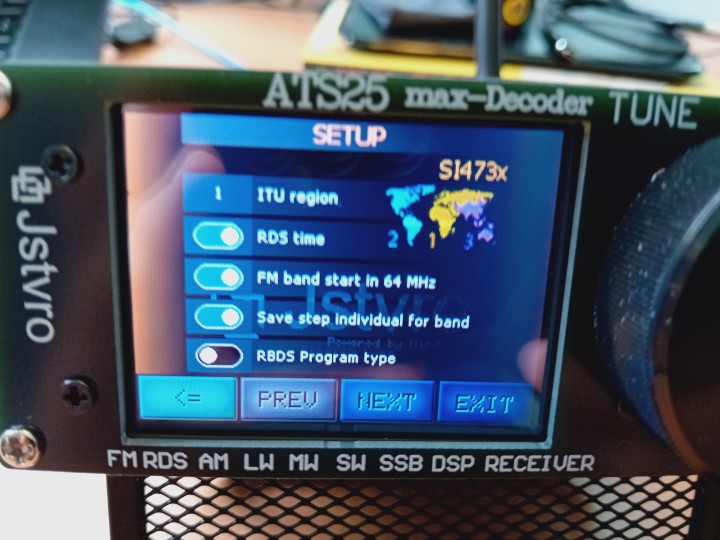
Menus... the ATS25 max-Decoder has pages and pages of them.
The most reassuring thing to know is that Elektor supplies the ATS25 max-Decoder complete with the registered product key, so you do not have to apply for one with the makers. The product key is shown prominently when you switch on the radio. I suggest you write it down and keep it in safe place. Next, the challenge is to find the menu where the radio can log on to your Wi-Fi network. Duh, that’s on one of the last pages of the SETUP menu! After switching on the radio, press NEXT, then SETUP, then NEXT (about 15 times!) until you see the “BT/Wi-Fi” menu. There, switch on: “Wireless on” and then “Select AP”. The next step is to select the desired Wi-Fi network and enter the password. My Wi-Fi scan failed a number of times, the software hung up, and I was forced to switch the radio off and on again. Exit the menu and Save your settings. Back in radio mode, touch the Wi-Fi symbol on the screen (it’s tiny!) and it will light up green. You are now connected and ready to benefit from the brilliant online utilities created by the Jstvro group specially for the ATS25 max-Decoder.
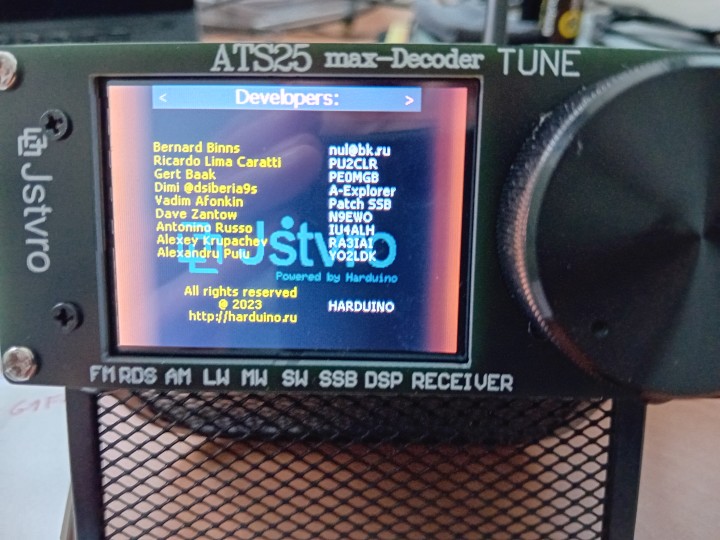
Credit where credit is due. 73 to the developers!
With your registration key, you are also eligible for software updates. My radio indicates it’s running version “Air 4.17 Beta” and I wasn’t able to select “Bluetooth” in the BT/Wi-Fi menu, so I guess this requires an update or an extension of some sort in the near future.
Likes and Likeables
The “Retro” tuning scale and S-Meter, as well as the FT8 mode and the CW decoder soon became my favorite features of this ESP-powered radio with its incredible number of options and features.
Totally charming: the "retro" mode for the frequency scale!
The sheer portability of the radio plus its rechargeable battery which lasts many hours make it a great choice for outdoor use well away from man-made noise. Tuning and operation of the ATS25-max Decoder are a delight once you’ve got the hang of using the supplied stylus to pick the right menus. The sound quality from the internal speaker is good but I prefer to plug in my headphones — borrowed from my Samsung smartphone set. They work better and will not annoy your housemates.
For this review, I did not have time to set up an IDE on my PC, run PUTTY at 115,200 baud and read decoded messages and station information on my PC.
What’s missing? Not much and certainly feasible things in the future as the radio is a software powerhouse really. I would have loved:
VLF band reception, say 50 kHz to 200 kHz for DCF/MSF timekeeping stations, lowfers, etc.
VHF Airband reception (not allowed in all countries)
NBFM for the CB band (40 channels, European)
A little less Italian in the (English) Manual
Better guidance for the Wi-Fi setup
Now, since the ATS25 max-Decoder is ESP32 powered and Elektor readers are both numerous and knowledgeable as far as coding for this platform goes, I’m confident all of the above points can be fulfilled if not overcome “S9” (with great success).
The ATS25 max-Decoder with preregistered product key is available as an Elektor Labs Selected product from the Elektor Store.
Subscribe
Tag alert: Subscribe to the tag Review and you will receive an e-mail as soon as a new item about it is published on our website!



Discussion (8 comments)