Review: The UM25C USB tester with colour LCD and Bluetooth
The Elektor department for tools, equipment, kits also contains some really useful articles: Some of my more recent articles include the DVB-T USB sticks as DAB radio and QI chargers for smartphones (which will be appearing shortly) and for these I used a plug in USB tester to take measurements of USB voltage and current drawn by the USB devices. I am now however in possession of a similar but much more capable measurement device. What additional features does this neat bit of test gear offer?
The Elektor department for tools, equipment, kits also contains some really useful articles: Some of my more recent articles include the DVB-T USB sticks as DAB radio and QI chargers for smartphones (which will be appearing shortly) and for these I used a plug-in USB tester to take measurements of USB voltage and current drawn by the USB devices. I am now however in possession of a similar but much more capable measurement device. What additional features does this neat bit of test gear offer?
Maybe you are just curious and want to find out how much power a device plugged into a USB port is drawing. Alternatively you maybe developing a USB-powered device and wish to find, more precisely how much energy it takes, either way you will usually use a USB breakout board together with a multimeter in between the USB port and device to measure voltage and current. There is however a far more convenient alternative which does away with the need for any hookup wires, breakout boards or additional equipment…
Measuring USB power
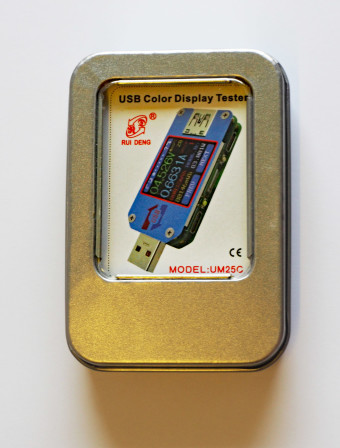
A USB-Stick in a tin.
Industry has not overlooked the fact that there are now billions of USB ports the world over, and many of the USB devices plugged into the ports can, now and again misbehave and cause problems. Engineers are curious by nature and like to find out what’s going on so that when a similar situation arises they know where to look for a solution. Often it is first necessary to isolate the USB device by inserting an adapter board in the USB connection to make current and voltage measurements. Even better is to use a USB tester which has all the measuring capabilities built-in.
A simple USB tester
It is possible to buy for just a few pounds or dollars, a really basic plug-in USB tester which uses a three-character (7-segment) LED read-out to indicate voltage and current values. For many applications this may be all you need to give a rough idea of what’s happening at the USB port. These offer a measuring resolution of 10 mV (which may be acceptable) but only 10 mA current resolution (which is often not precise enough) making these low-cost versions more suitable for general purpose testing. To make measurements in the articles listed, I therefore needed ‘something better’ in the form of a stick called the ‘USB Safety Tester’ which comes in at just under €20 and provides better measurement resolution, more features and a small black and white OLED display. One important consideration to be aware of when measuring USB devices such as Qi chargers is that they are able to supply a voltage level up to 20 V to achieve faster charging for the Quick Charge standard. That voltage level would be enough to fry a simple cheap USB tester.
A USB tester with color display
Under the lid
It’s logical that any Super-Duper USB tester has got to meet all the criteria listed above, so it must be able to cope with Quick Charge voltage levels and accurately make measurements with high resolution. Any other additional features it has will also be gladly accepted.
So here it is; the new tester. Not in the usual plastic blister pack but in a cool Altoids-like metal box with a window in the lid.
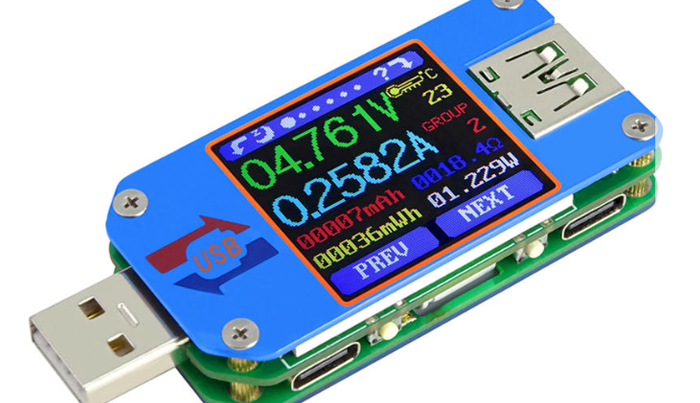
It certainly looks good and what’s better is the built-in 1.44" (3.7 cm) diagonal display, its color LCD means it’s bright and really easy to read under different lighting conditions, in addition to the type number (UM25C), you can see that thanks to its five-character display, it is able to show voltage measurements with 1 mV resolution and current measurements with 0.1 mA resolution. What more could you possibly want?
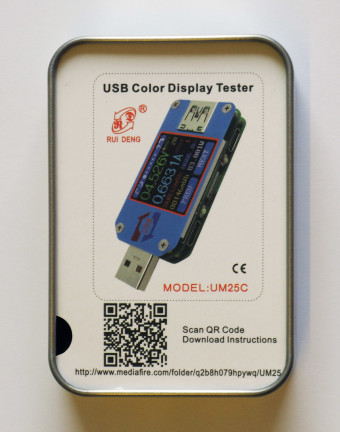
It goes without saying that the tester also has loads more functions available. It can show the battery charging process (in mAh and mWh) and monitor the load resistance and actual power. As for USB sockets there are of course more than just the standard USB-A. When you pop off the box lid a QR code is revealed which takes you to a website with extensive instructions and software.



Discussion (0 comments)