


Heatsinks
on

Proper heat dissipation is of paramount importance for the correct functioning and stability of any electronic design. For this purpose, heatsinks are available in various shapes and sizes. Let's take a look at the main types here.
The theme of this issue is Prototyping and Production. [Editor's note: this article is scheduled to appear in Elektor Nov/Dec 2025, which is focused on prototyping and production.] A very necessary part of this is making sure that any heat-dissipating components are kept at a safe temperature; if not, you are looking at early failures or damage to your equipment.
Heatsinks are pretty mundane components; they have no electronic function at all, but correct selection and use of heatsinks is a very necessary part of production. And the choice of heatsinks is huge. From tiny fins that clip onto TO-92 and TO-5 transistors, to aluminum extrusions that clip or are screwed to the ubiquitous TO-220 and larger flatpack semiconductor packages, to huge fins that can cool multiple transistors or a PC processor chip, they come in almost endless variety.
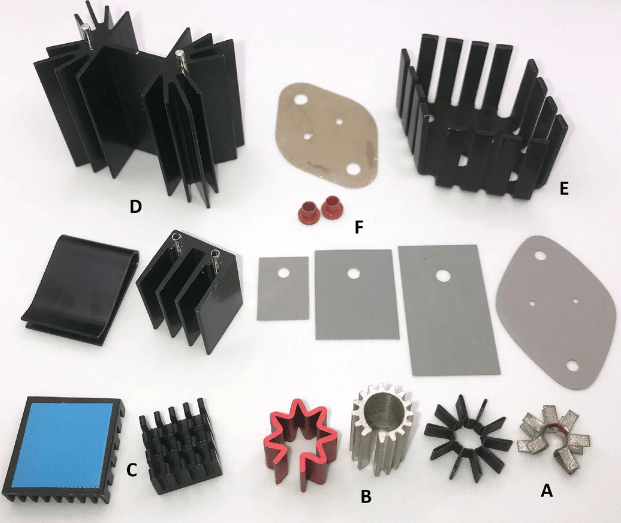
heatsinks for TO-5 transistors (B), two self-sticking types for surface mount ICs — such
as those used in the Raspberry Pi (C), PCB and clip-mounting heatsinks for TO-220 and
larger devices (D), PCB-mount heatsink for a TO-3 device (E). Various insulating hardware,
with a mica washer (top), two red insulating bushes to isolate screws from heatsinks, and
different gray silicone insulating washers (F).
Heatsinks are often anodized black — if you remember your high school physics, black bodies radiate heat better than bare-metal ones. If you’ve ever had to mount multiple transistors on one heatsink, you’ll have come across the various types of insulating hardware, like silicone and mica washers and Teflon bushes, intended to keep the cooled devices from making electrical contact with the heatsink.
Heatsinks have a metric of °C of temperature rise per watt of heat they dissipate, though insulating washers complicate calculations.
Thermal contact is important, however, and a silicon grease compound is used to better conduct heat between the transistor and the heatsink surfaces — which are never completely smooth — and the heat-transfer compound fills in the minute gaps.
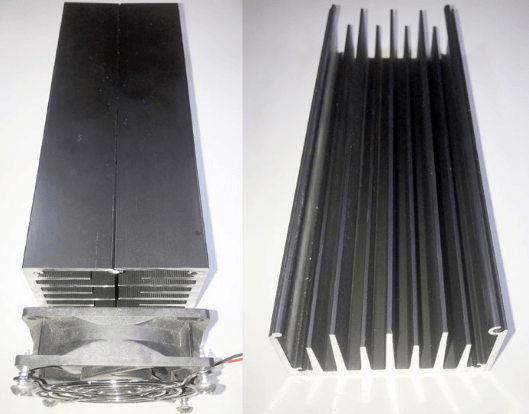
standalone (right), or in two parts clipped together with a
fan mounted to them (left), for even better cooling.
Active Heatsinks
On larger heatsinks, fans are often used to provide forced-air cooling to remove heat from the heatsink faster than natural convection can do. Heat pipes are also used for efficient heat transfer, but they are a subject to themselves and maybe one for a future article!
Dust is the number one enemy of any ventilated heatsink. It impedes airflow and acts like a blanket, keeping heat in. Especially when fans are used, dust is likely to build up. An external filter is more easily cleaned than an internal heatsink.
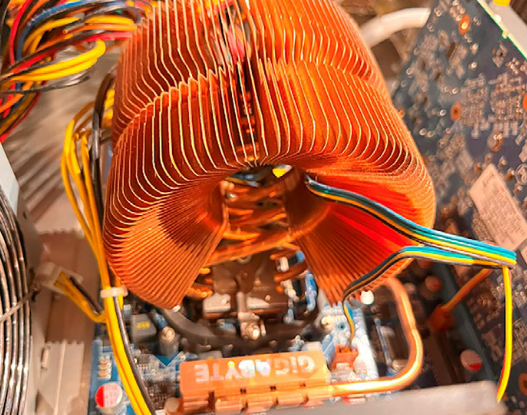
both forced ventilation and heat transfer pipe technologies
Figure 1 shows a selection of heatsinks for various transistors, up to TO-220 and TO-3 size. They mount either directly on the transistor, or the heatsink is attached to the PCB and the transistor is screwed to the heatsink. Also shown is some insulating hardware — a TO-3 mica washer (transparent), various silicone washers (gray), and some insulating bushes that insulate mounting screws from heatsinks.
Figure 2 shows a two-part heatsink. The parts can be used standalone (right) or clipped together and a fan mounted to them (left) for even better cooling. Figure 3 shows a PC processor heatsink; they are often large and decorative!
Editor's Note: This article (250619-01) is slated for publication in Elektor November/December 2025.
Questions About Heatsinks?
If you have technical questions or comments about heatsinks or this article, feel free to contact the Elektor editorial team at editor@elektor.com.

Discussion (0 comments)