


ENS210 humidity/temperature sensor BOB
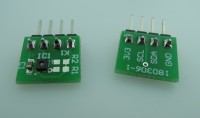
Breakout board for AMS I2C ENS210 humidity/temperature sensor
Like many (or most?) other modern sensors this ENS210 is very small, measuring only 2 x 2 x 0.75 mm in a QFN4 package. The downside is that this sensor is very difficult to solder, not only because of its small size, but it also has an exposed pad underneath that must be soldered to GND, leaving no other choice than using solder paste and hot air to solder this sensor to a PCB. (Okay, for prototypes or experiments another option would be to solder tiny wires to the 5 pads). For soldering our prototype BOBs I first gave it a try with our hot air soldering station, which eventually worked, but the reflow oven gave much better results.
We designed this BOB to offer a pre-soldered sensor on a board that connects to the outside world via a standard 4-way 100 mil pitch pinheader, that can also be plugged into a standard breadboard. There are also footprints on the PCB for accommodating I2C pull-up resistors on the SDA and SCL connections, but they are not mounted on the pre-assembled BOB in our shop. Often times these resistors are already present in the host-system, but please note that they should always be pull-ups to 3.3V (3.6 max!) and NOT to 5V. Exceeding the ENS210 maximum input voltage will kill the sensor, so don’t even try.
Although the I2C bus has an open drain configuration with the aforementioned pull-up resistors, it is not recommended/good practice to connect 3.3V I2C sensors to 5V host systems with the resistors connected to 3.3V. Once running it will work and keep working (in most cases), but during boot up of the I2C master processor the mode and state of its I/O pins is sometimes unpredictable. Don’t take any risk and always use bidirectional 3.3V <-> 5V voltage level shifters between 5V and 3.3V devices on the I2C bus.
There is an Arduino ENS210 library with examples available on github (https://github.com/maarten-pennings/ENS210), which we tested in Arduino 1.8.5 IDE with an Arduino Due processor board.
ENS210 parameters
Interface I²C
Supply Voltage 1.71 to 3.6 V
Consumption 7.1 µA @ 1 Hz (standby: 40 nA)
Dimension 2 x 2 x 0.75 mm
Ambient Temp. Range -40 to 100 °C
Accuracy ±0.2°C; ±3.5% r.h.
Conversion Time 122 ms
BOM
Resistor
R1,R2 = NOT MOUNTED *
Capacitor
C1 = 100 nF, 50 V, X7R, 0603
Semiconductor
IC1 = ENS210 relative humidity & temperature sensor
Other
K1 = Pin header, breakable, 1 row, 4-way, horizontal, pitch 100mil
PCB 180306-1 V1.0
We designed this BOB to offer a pre-soldered sensor on a board that connects to the outside world via a standard 4-way 100 mil pitch pinheader, that can also be plugged into a standard breadboard. There are also footprints on the PCB for accommodating I2C pull-up resistors on the SDA and SCL connections, but they are not mounted on the pre-assembled BOB in our shop. Often times these resistors are already present in the host-system, but please note that they should always be pull-ups to 3.3V (3.6 max!) and NOT to 5V. Exceeding the ENS210 maximum input voltage will kill the sensor, so don’t even try.
Although the I2C bus has an open drain configuration with the aforementioned pull-up resistors, it is not recommended/good practice to connect 3.3V I2C sensors to 5V host systems with the resistors connected to 3.3V. Once running it will work and keep working (in most cases), but during boot up of the I2C master processor the mode and state of its I/O pins is sometimes unpredictable. Don’t take any risk and always use bidirectional 3.3V <-> 5V voltage level shifters between 5V and 3.3V devices on the I2C bus.
There is an Arduino ENS210 library with examples available on github (https://github.com/maarten-pennings/ENS210), which we tested in Arduino 1.8.5 IDE with an Arduino Due processor board.
ENS210 parameters
Interface I²C
Supply Voltage 1.71 to 3.6 V
Consumption 7.1 µA @ 1 Hz (standby: 40 nA)
Dimension 2 x 2 x 0.75 mm
Ambient Temp. Range -40 to 100 °C
Accuracy ±0.2°C; ±3.5% r.h.
Conversion Time 122 ms
BOM
Resistor
R1,R2 = NOT MOUNTED *
Capacitor
C1 = 100 nF, 50 V, X7R, 0603
Semiconductor
IC1 = ENS210 relative humidity & temperature sensor
Other
K1 = Pin header, breakable, 1 row, 4-way, horizontal, pitch 100mil
PCB 180306-1 V1.0
Want to build a project?
Bring your design to life with the Elektor PCB Service, powered by Eurocircuits. Upload the project files and order professionally manufactured PCBs or assembled boards through a proven European production platform.
Supporting KiCad, Eagle, Gerber, and ODB++ formats, the service is suitable for everything from prototypes and validation builds to series production and volume manufacturing.
Made in Europe. Fast. Reliable. Professional.
Discussion (0 comments)