


Dual Output DC/DC Converter
May 13, 2015
on
on
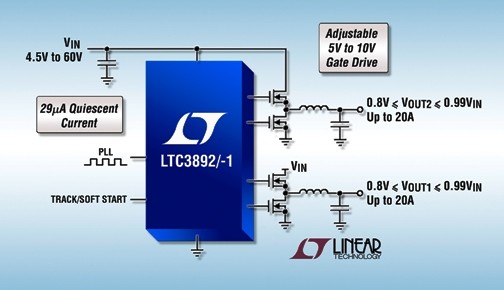
Linear Tech has recently added the LTC3892 voltage regulator chip to their already impressive palette of voltage regulator devices. The LTC 3892 is a dual step-down DC/DC switching regulator controller that drives external (all N-channel) synchronous power MOSFET stages. Power losses and noise in the system are minimized by operating the two controller output stages out-of-phase. The controller can be programmed to operate with FETs with standard gate voltage characteristics or FETs with logic-level drive. Internal switches in the top-gate drivers ensure that external bootstrap diodes are not required in the design.
The input voltage range is an impressive 4.5 to 60 V and its low dropout voltage means that it will still be working with a Vout approaching 99% of Vin. Linear Tech’s OPTILOOP compensation feature allows the transient response and loop stability to be optimized while working into loads with a wide range of capacitance and ESR values.
The 29 µA no-load current (one channel ON) and 3.6 µA (shutdown) current ensures good battery life when the regulator is used in mobile devices. The LTC3892 is available as a 32-lead 5 x 5 mm QFN outline and the LTC3892-1 as a 28-lead TSSOP package.
The input voltage range is an impressive 4.5 to 60 V and its low dropout voltage means that it will still be working with a Vout approaching 99% of Vin. Linear Tech’s OPTILOOP compensation feature allows the transient response and loop stability to be optimized while working into loads with a wide range of capacitance and ESR values.
The 29 µA no-load current (one channel ON) and 3.6 µA (shutdown) current ensures good battery life when the regulator is used in mobile devices. The LTC3892 is available as a 32-lead 5 x 5 mm QFN outline and the LTC3892-1 as a 28-lead TSSOP package.
Read full article
Hide full article