Arduino 20th Anniversary: Padua Students Build Prototypes
Arduino 20th anniversary celebrations at the University of Padua produced three student-built prototypes, from a gesture-controlled vehicle to an ultra-low-power sensing node and a swim-tech wearable. The projects came out of a summer competition run by the university’s IEEE Student Branch, with final presentations held in November.
Arduino 20th anniversary celebrations are more interesting than a cake-and-speeches affair: Last month, students at the University of Padua used the milestone as an excuse to build and demo real prototypes, then present them publicly at the Department of Information Engineering.
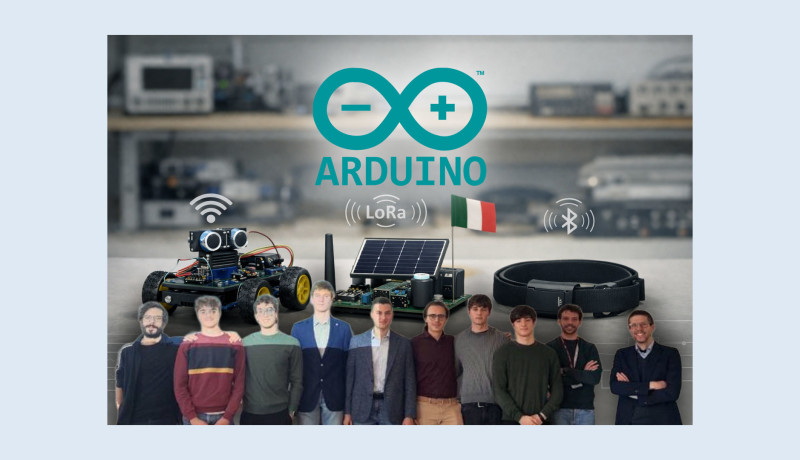
The University of Padua’s IEEE Student Branch recently held a special competition to push the boundaries of what’s possible with Arduino. Source: Arduino
According to the original post, the IEEE Student Branch ran a summer-long competition and wrapped it up with project presentations on November 19, 2025.
Arduino 20th Anniversary Challenge at the University of Padua
The contest format was straightforward: build something tangible, explain the engineering choices, and show it working. Professor Matteo Meneghini (IEEE Student Branch advisor) framed it as a way to practise design trade-offs, teamwork, and turning ideas into working hardware.
Martino Facchin. Source: Arduino
Arduino’s Hardware/Firmware Manager Martino Facchin attended, and the top teams received a €150 discount to buy more hardware for their next iterations.
Arduino 20th Anniversary Projects
Three projects stood out because they’re recognizably “maker” ideas, but with enough engineering ambition to be worth dissecting.
Gesture-Controlled Vehicle With Radar Sensing
A team built a remote-controlled car that uses camera-based hand-gesture recognition, then sends commands over Bluetooth to the vehicle.
The gesture side runs a Python-based machine-learning workflow. The vehicle stack includes an Arduino UNO R4 WiFi, an HC-05 Bluetooth module, four 6 V gear motors, and a second Arduino UNO that drives an ultrasonic-sensor-and-servo “radar” for obstacle detection, supporting both manual and automatic modes.
For background on the UNO R4 platform, see our UNO R4 overview.
Solar-Powered Environmental Monitoring With Aggressive Power Budgeting
Another team built an environmental monitoring station split into a sensor “Spot” module and an upload “Hub” module, with the Hub feeding data into Arduino Cloud.
The interesting angle is power: The Spot runs from a solar panel and supercapacitors and targets operation around 2.2 V, using a Texas Instruments energy-harvesting IC intended for milliwatt-scale collection. An Arduino Nano ESP32 handles sensing and power distribution, while LoRa provides the radio link between modules.
The team noted they dropped below the usual Arduino abstractions and used lower-level ESP32 tooling to gain more control and efficiency.
Swim-Tech Wearable Using BLE Packets and Motion Sensors
The third project is a wearable anklet for swimmers: it measures acceleration plus gyroscope and magnetometer data, then looks for patterns that correspond to turns and stroke/kick quality. Data is transmitted in small packets over Bluetooth Low Energy (BLE) to a Kotlin-based companion app. Their main challenge was getting BLE working reliably and fast enough to be useful.
What This Arduino 20th Anniversary Story Signals
This is a tidy snapshot of how Arduino gets used in university settings: quick prototyping to reach a demo, followed by real engineering constraints (power architecture, wireless protocols, data pipelines, and software stacks) once the first prototype works.
Subscribe
Tag alert: Subscribe to the tag Arduino and you will receive an e-mail as soon as a new item about it is published on our website!
Read full article
Hide full article
About Brian Tristam Williams
Brian Tristam Williams is a content creator who’s had a passion for computers and electronics since he got a “microcomputer” at age 10. He bought his first Elektor Magazine at 16, and has been orbiting the electronics and computers ecosystem since. He first co... >>





Discussion (0 comments)