


Automotive radar controller
January 18, 2017
on
on
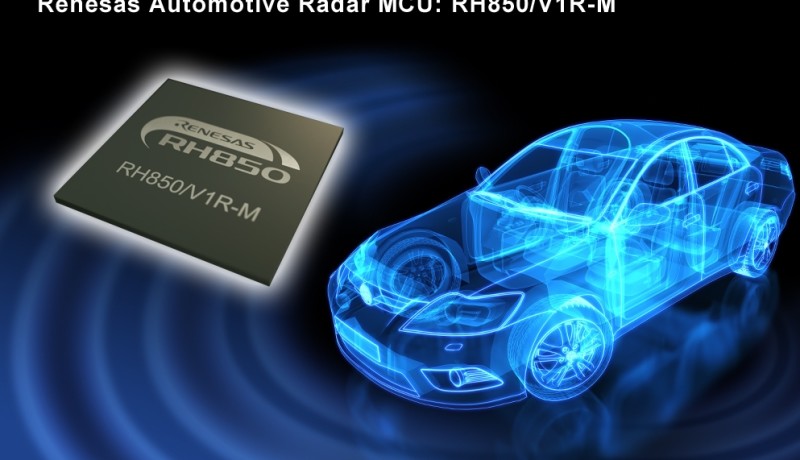
As a consequence of the rapid rise of ADAS systems (Advanced Driver Assistance Systems) and the continual progress in the development of autonomous vehicles, sensors are going to play an increasingly important role. Modern cars are often equipped with cameras, lidar and ultrasonic sensors. For ADAS systems, radar sensors in particular, are also very important, because they are not affected, or much less so, by external factors (rain, fog, sunlight, etc.)
Renesas Electronics introduces, especially for automotive radar applications, a 32-bit microcontroller, the RH850/V1R-M, which has a high performance and has many features on board that are necessary for safety related applications in modern cars. The dual-core microcontroller has, among other things, a separate digital signal processor (DSP) and high speed serial interfaces.
The versatile programmable DSP carries out radar specific calculations such as Fast Fourier Transform (FFT), beam forming and channel calibration quickly, efficiently and independently of the two CPUs.
Renesas offers a mathematics library specifically for this DSP to support system designers with the development of their algorithms. Various tools and evaluation kits are also available.
Renesas Electronics introduces, especially for automotive radar applications, a 32-bit microcontroller, the RH850/V1R-M, which has a high performance and has many features on board that are necessary for safety related applications in modern cars. The dual-core microcontroller has, among other things, a separate digital signal processor (DSP) and high speed serial interfaces.
The versatile programmable DSP carries out radar specific calculations such as Fast Fourier Transform (FFT), beam forming and channel calibration quickly, efficiently and independently of the two CPUs.
Renesas offers a mathematics library specifically for this DSP to support system designers with the development of their algorithms. Various tools and evaluation kits are also available.
Read full article
Hide full article
Discussion (0 comments)