Want to experiment with the Raspberry Pi? Joy-iT's Joy-Pi experimenter's kit simplifies the process of getting started with a Raspberry Pi 3B, 3B+, or 4. The sturdy case is packed with sensors and modules for countless projects.
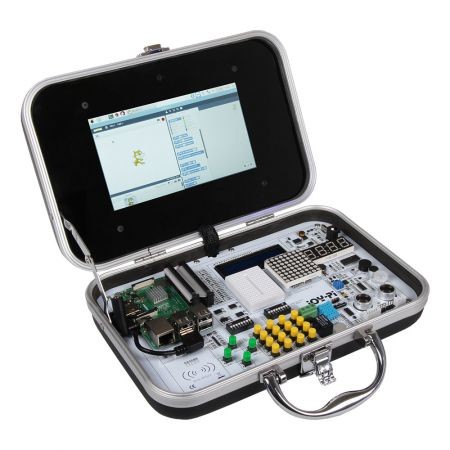
There are plenty of starter kits available, also for the Raspberry Pi. They are meant to get people started with the hardware and software of a certain product family, and they tend to be particularly suitable for education and self study. JOY-iT has put a very extensive experimenter's kit on the market for the Raspberry Pi: the Joy-Pi. It is designed to be used with a Raspberry Pi board version 3B, 3B+ or 4. The hardware is built into a sturdy case — a solid, laptop-like housing — which makes it possible to store everything neatly and safely between experiments and lessons. Let's have a look at what this kit has to offer.
Joy-Pi Essentials
The Joy-Pi is very suitable for school projects, because it can be turned off, shut down and closed at the end of a lesson. A student can then continue to work on the project during the next lesson. Another advantage of the suitcase is its great mobility and compactness. As a result, you can take it everywhere and explore the universe of the Raspberry Pi together with friends.
The Joy-Pi has a large number of sensors and modules which, thanks to the very detailed application examples, can be operated independently. Thanks to the prepared SD card containing the operating system image, the Joy-Pi is immediately ready for use after you have connected the power supply. With a 7-inch touch display integrated in the lid, you can operate the Raspberry Pi and display directly the evaluations of the integrated sensors. With the integrated breadboard, you can connect and use additional external sensors and modules or self-constructed circuits.
The Joy-Pi case contains the following sensors:
Light sensor
Sound sensor
Motion sensor
Ultrasonic distance sensor
Tilt sensor
Touch sensor
Temperature and humidity sensor
Infrared sensor (receives signals, for example, from the included infrared remote control)
And it includes the following modules:
GPIO LED display
16 x 2 character LCD module
8 x 8 LED matrix
7-segment LED display
Buzzer
Relay
Push button matrix, independent buttons
RFID module
5 V stepper motor
Servomotor
7-inch IPS touch display
Camera (installed in the lid above the display)
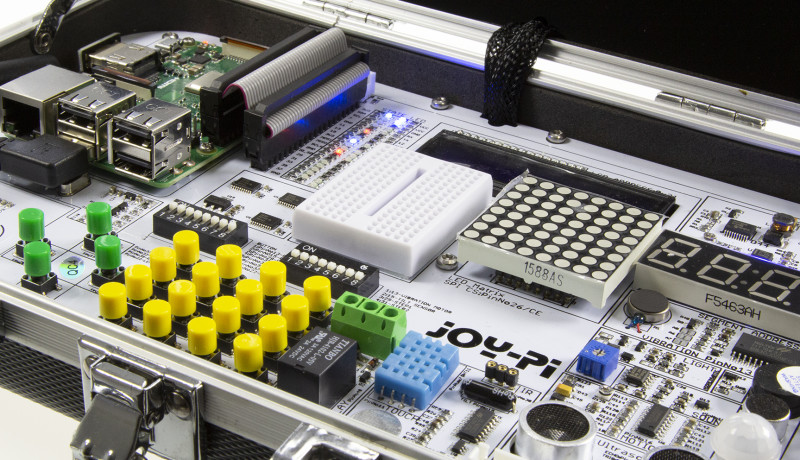
Raspberry Pi board (top left) and some of the Joy-Pi hardware.
Unlimited Possibilities
Once you have learned how the sensors and modules in the Joy-Pi work, there are almost unlimited possibilities to extend the sample programs and combine the individual components in your own applications. For example, you can combine the LEDs with the motion sensor and the light sensor to turn on the LEDs when motion is detected in the dark. Or you can use the keys to influence the pitch of the buzzer and build a kind of small piano. There are no limits to your imagination. And if you do not want to experiment with the case, you can also use it as a small laptop and connect a keyboard and mouse to the Raspberry Pi via USB or BT. For this purpose, a small keyboard is included in the delivery, which is controlled via BT and has also a touchpad to control the mouse.
It is important to note that the Raspberry Pi board itself is not included in this kit. Still, the Joy-Pi is very complete in terms of software and hardware for experimenting and learning with the Raspberry Pi.



Discussion (0 comments)