


Review: Espressif ESP32-PICO-KIT Getting Started Guide
January 8, 2018
on
on
Two cores and a radio
The ESP32 is the latest product from the folks that brought us the ESP8266. Like the ESP8266 the ESP32 has Wi-Fi, but adds Bluetooth. Besides a flexible radio the ESP32 also has two 32-bit cores inside, making it extremely powerful, and providing all the ports and interfaces that the ESP8266 is lacking. Oversimplifying things a bit, one might say that the ESP8266 is a Wi-Fi controller that provides some I/O, whereas the ESP32 is a full-fledged controller that also has Wi-Fi.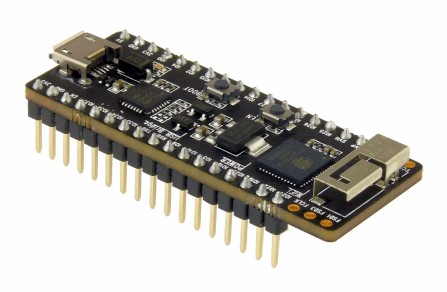
ESP32 peripherals
The ESP32 exposes an analogue-to-digital and digital-to-analogue converter (ADC & DAC), touch sensor circuitry, an SD/SDIO/MMC host controller, an SDIO/SPI slave controller, an EMAC, PWM to control LEDs and motors, UART, SPI, I2C, I2S, infrared remote controller, and, of course, GPIO.The ESP32-PICO-D4 is a System-on-Chip (SoC) integrating an ESP32 chip together with a 4 MB SPI flash memory in a tiny 7 x 7 mm package. The ESP32-PICO-KIT is a breakout board for this SoC with an on-board USB-to-serial converter for easy programming and debugging.

ESP32 Design Contest
The ESP32-PICO-KIT is the board that is given for free to anyone joining the Elektor ESP32 Design Contest.Read the docs
For the ESP8266 most of the documentation and tutorials were written by the maker community, for the ESP32 Espressif decided to provide it all right from the beginning. The documents are posted on the Read the Docs website where you can find the very complete documentation.Prepare for the ESP32-PICO-KIT
To get started with the ESP32-PICO-KIT you will need, besides the board (duh), a programming toolchain. There exists an Arduino-compatible toolchain for the ESP32 but it is intended for an ESP32 board with a different pinning and without the 4 MB flash memory.Read full article
Hide full article
Discussion (0 comments)