| This 288 MHz generator was designed for use in a transverter (transceiver converter) to allow a two-metre ( 144 MHz) transceiver to operat...



More about generator (343)
€5 (FREE for Members)

€5 (FREE for Members)

| The design of this squarewave generator is identical to that of the circuit described above, with the exception that it employs an IC fro...
€5 (FREE for Members)

| The design of this squarewave generator is identical to that of the circuit described above, with the exception that it employs an IC fro...
€5 (FREE for Members)

| It is possible to reduce distortion in r .f. amplifiers by employing negative feedback. When using this technique, however, it is important...
€5 (FREE for Members)

| The 723 is a very widely used IC regulator. Hence the following cir-cuit, which is intended to reduce power dissipation when the 723 is used...
€5 (FREE for Members)

| The automatic call-sign generator, which was published in Elektor 10, February 1976, relieved radio amateurs of the chore of having to pe...
€5 (FREE for Members)

| Using only one inexpensive CMOS IC and a handful of discrete components, it is possible to build a versatile function generator that wi...
€5 (FREE for Members)

| ust twelve months ago, issue 21 contained an article on the digital synthesis of noise using a pseudo-random binary sequence generator. The...
€5 (FREE for Members)

| A function generator is a versatile and extremely useful device, which provides the constructor with a simple and efficient means of test...
€5 (FREE for Members)
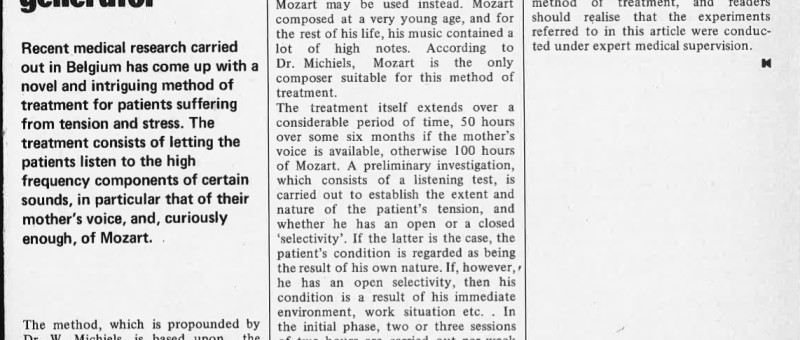
| Recent medical research carried out in Belgium has come up with a novel and intriguing method of treatment for patients suffering from...