


LED gravity balance
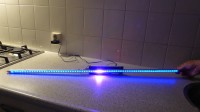
LED's and gravity ?? Sure ! In this project you will see how you can make LEDs react to gravity !
This project has no practical use at all, but was initiated as an exercise in implementing physics formulas related to gravity in C-code on an Arduino and to have some fun with LEDs. To make things visible, a neopixel LED-strip with 74 LEDs was used. The effect of the gravitational acceleration on an object is demonstrated by using a MPU-6050 module. This chip contains an 3-axis accelerometer and a 3-axis gyroscope chip. The MPU-6050 module is physically attached to the LED-strip, so when the LED-strip is held at a certain angle, the MPU-6050 acceleration data is used to calculate the angle of the LED strip and the Arduino uses this information to update the position of a virtual object as if it was a ball that is balanced on a beam and rolls from one side to the other if the beam is held at an angle. The position of the virtual object is indicated on the LED strip as a single LED that is illuminated. To update the position of a virtual object that is falling to the earth under the influence of gravity, we use the formula :
y = y0 + (V0 * t) + (0.5 * a * t^2)
y = travelled distance in meters
y0 = start distance in meters
v0 = start velocity in meters/second
a = acceleration (gravity) in meters/second^2
t = time in seconds
y = y0 + (V0 * t) + (0.5 * a * t^2)
y = travelled distance in meters
y0 = start distance in meters
v0 = start velocity in meters/second
a = acceleration (gravity) in meters/second^2
t = time in seconds
Want to build a project?
Bring your design to life with the Elektor PCB Service, powered by Eurocircuits. Upload the project files and order professionally manufactured PCBs or assembled boards through a proven European production platform.
Supporting KiCad, Eagle, Gerber, and ODB++ formats, the service is suitable for everything from prototypes and validation builds to series production and volume manufacturing.
Made in Europe. Fast. Reliable. Professional.
Updates from the author