


CERN plans another ring to rule them all…
January 28, 2019
on
on
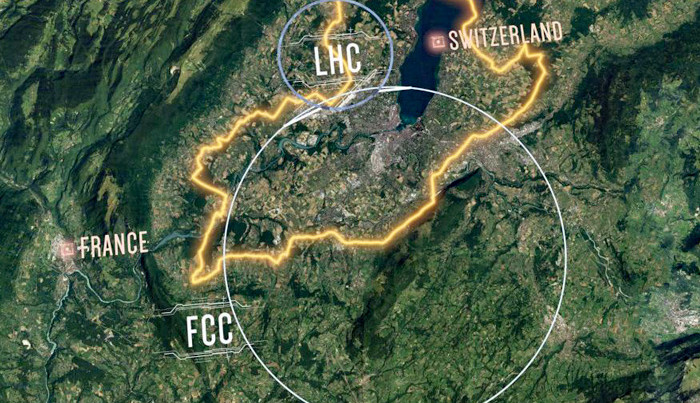
It’s big… but not big enough apparently – CERN in Geneva, are already plotting to build a new particle accelerator ring with a circumference of 100 km, that’s almost four times longer than the 27 km circumference of the existing LHC.
The plans drawn up by CERN have been submitted in a conceptual design report to be considered along with other submissions by an international panel of particle physicists, working on the European strategy for particle physics due for publication in 2020. Their design has been given the working name of the FCC or Future Circular Collider. The LHC currently accelerates particles around the 27 km circuit at a rate of 11,000 laps per second for 20 minutes before the two beams are allowed to collide. The larger loop of the FCC will enable the particles to collide with much higher energy levels thereby ripping them into ever finer sub-atomic shreds to reveal tantalising secrets of the nature of matter. The path of the proposed loop will take it under France and Switzerland.
The plans drawn up by CERN have been submitted in a conceptual design report to be considered along with other submissions by an international panel of particle physicists, working on the European strategy for particle physics due for publication in 2020. Their design has been given the working name of the FCC or Future Circular Collider. The LHC currently accelerates particles around the 27 km circuit at a rate of 11,000 laps per second for 20 minutes before the two beams are allowed to collide. The larger loop of the FCC will enable the particles to collide with much higher energy levels thereby ripping them into ever finer sub-atomic shreds to reveal tantalising secrets of the nature of matter. The path of the proposed loop will take it under France and Switzerland.
From the LHC to the FCC
If it all goes to plan the FCC should be operational by 2050, preliminary cost estimates are in the order of 20 billion Euros. The LHC currently holds the record for being the largest machine in the world so the FCC will easily take on this mantle when it is finished. There is a certain irony that we need to build the largest machines in order to find the smallest particles.Read full article
Hide full article
Discussion (2 comments)