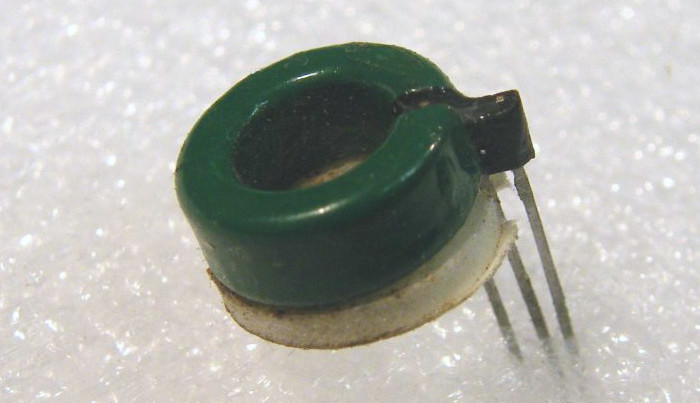
Current sensor uses the Hall effect. Image: Raztec
Raztec Sensors based in New Zealand produces a range of Hall current sensors in the RAZC series with a maximum rating from 40 to 250 A. The toroidal sensors have an outer diameter of only 11 mm and an inner diameter of 4.5 mm for the current-carrying conductor. The response time is in the range of a few tens to a hundred kHz...
Raztec Sensors based in New Zealand produces a range of Hall current sensors in the RAZC series with a maximum rating from 40 to 250 A. The toroidal sensors have an outer diameter of only 11 mm and an inner diameter of 4.5 mm for the current-carrying conductor. The response time is in the range of a few tens to a hundred kHz.
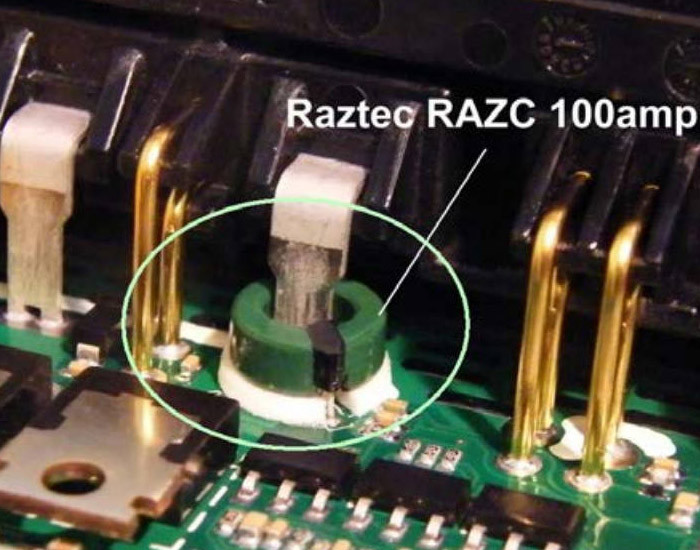
Measurement non-linearity, hysteresis and temperature deviation are typically less than 1%. The structure consists of an air-gapped ferrite toroid with a bonded Hall sensor measuring the field in the gap. The Hall sensor can withstand over-current events. Typical current-sensing application. Image: Raztec Sensors.
The typical application of these current sensors is the detection of current through motor windings. The conductor carrying motor current is routed through the centre of the current sensing toroid. The galvanic isolation offered by this configuration eliminates any common mode effects but still allows the precise measurement of the motor current.
With zero current flowing the output voltage is biased to half the supply rail. The output signal swing is large enough to be measured directly by an A/D converter input. Other applications for this type of sensor include solar PV installations and battery management systems.
The range of sensors include:
RAZC-2: ± 100 A, 35 kHz, 15 mV/A
RAZC-204CUAN: ± 200 A, 200 kHz, 10 mV/A (6.6 mV/A at 3.3 V)
RAZCHC-15: ± 80/120 A, 120 kHz, 15 mV/A
RAZCH: ± 100/300 A, 120 kHz, 7 to 22 mV/A adjustable
RAZCP: ± 80/140 A, 30 kHz, 16.7 mV/A (up to ± 80 A 0.1% linear)



Discussion (0 comments)