


Oscilloscope features 34 high-voltage channels at 1 GS/s
November 27, 2016
on
on
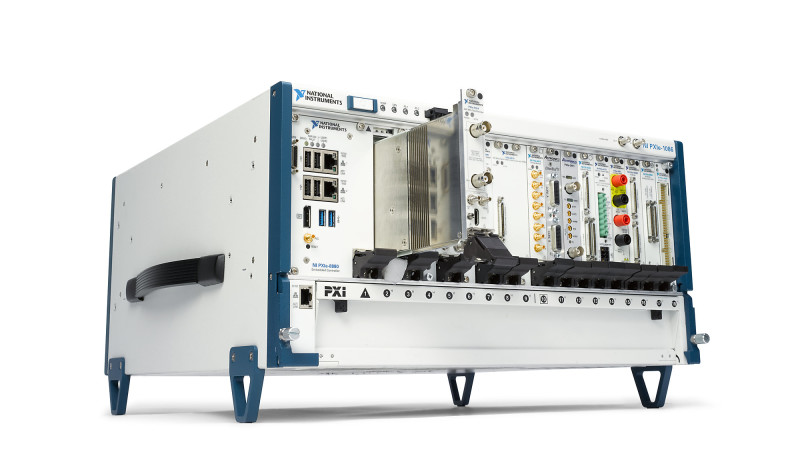
OK, that title is maybe a bit too catchy, in reality this item is about a two-channel high-speed, high-resolution, high-voltage oscilloscope module of which several can be put in parallel to obtain such a monster. The oscilloscope module itself has pretty impressive specifications, like a 100 Vpp input voltage range with a ±250 Vpp offset, a sample rate of 1 GS/s and two 14-bit, 400 MHz bandwidth channels.
It is the new PXIe-5164 from National Instruments we are talking about here and it is more than just an oscilloscope. It has a user-programmable Xilinx Kintex-7 410 FPGA inside allowing the user to create his/her own algorithms including filtering and triggering. Being an NI product, it can of course be programmed through LabVIEW. A traditional oscilloscope interface is available through the NI-Scope software with which you can make basic measurements, debug automated applications or view the scope data while the test program runs. It also includes a programming interface that works with a variety of development environments such as C, Microsoft .NET and, of course, LabVIEW.
It is the new PXIe-5164 from National Instruments we are talking about here and it is more than just an oscilloscope. It has a user-programmable Xilinx Kintex-7 410 FPGA inside allowing the user to create his/her own algorithms including filtering and triggering. Being an NI product, it can of course be programmed through LabVIEW. A traditional oscilloscope interface is available through the NI-Scope software with which you can make basic measurements, debug automated applications or view the scope data while the test program runs. It also includes a programming interface that works with a variety of development environments such as C, Microsoft .NET and, of course, LabVIEW.
Read full article
Hide full article
Discussion (0 comments)