Got some spare time on your hands, and a few thousand transistors lying around? (say, 42,000?) Then consider building a megacomputer like James Newman did over the past few years. All James wanted initially was “to learn about transistors. But things got out of hand.”
Got some spare time on your hands, and a few thousand transistors lying around? (say, 42,000?) Then consider building a megacomputer like James Newman did over the past few years. All James wanted initially was “to learn about transistors. But things got out of hand.” Some numbers may help to put things in perspective:
16-bit design with 4 general-purpose registers;
1 program counter;
1 processor status register;
1 stack pointer;
256 bytes of memory (27,000 transistors);
500-W power supply;
15,300 transistors in CPU of which 8,500 as LED drivers.
20 kHz clock speed absolute max., 8 kHz typ.
272,300 hand soldered joints;
50,500 resistors;
10,500 LEDs
weight: 500 kg approx.;
Investment: £ 40,000 approx.;
James is single and lives in Cambridge.
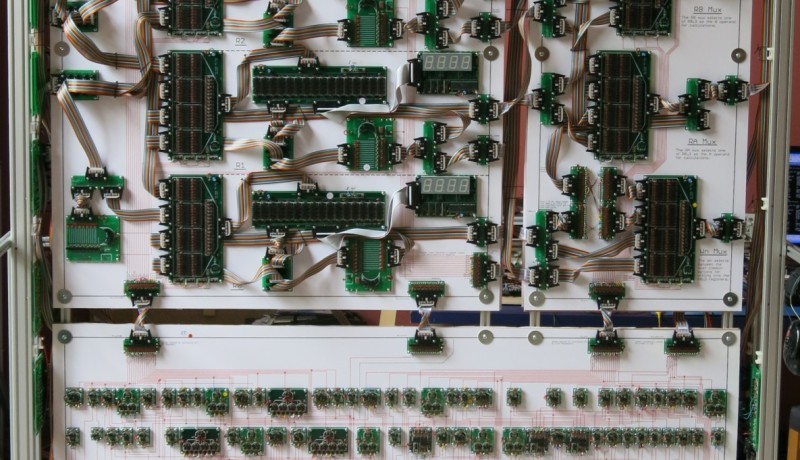
Seeing is believing in more than one way. “Computers are quite opaque,” Newman said. “Looking at them, it’s impossible to see how they work. What I would like to do is get inside and see what’s going on. Trouble is we can’t shrink down small enough to walk inside a silicon chip. But we can go the other way; we can build the thing big enough that we can walk inside it. Not only that we can also put LEDs on everything so we can actually SEE the data moving and the logic happening. It’s going to be great.” And indeed the address bus activity after an instruction like MOVX is a complete light show! Image credit: James Newman
James did not comment on a suggestion from that a floating point unit (FPU) will significantly speed up his behemoth machine, and that a simple Intel 387 could be tucked away easily behind the existing CPU panel (1.5 m wide) and stealing just 10 watts or so. And no-one knowing except Elektor readers.
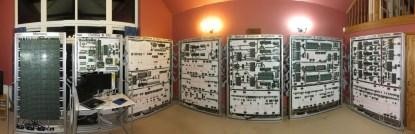
The megacomputer turned out to be slightly inconvenient in James’ home and is now residing at the Centre for Computing History in Cambridge.



Discussion (0 comments)