Review: Sunfounder IoT Shield Kit for Arduino delivers the goods
Even though the Internet of Things or IoT has been buzzing for a while now, it still remains somewhat inaccessible to many people. The Sunfounder IoT Shield Kit reviewed in this article tries to change this by providing easy-to-use add-on boards for the popular Arduino platform. With the kit anyone with a bit of electronics and programming experience (and some perseverance) can create an internet-connected object.
Even though the Internet of Things or IoT has been buzzing for a while now, it still remains somewhat inaccessible to many people. The Sunfounder IoT Shield Kit reviewed in this article tries to change this by providing easy-to-use add-on boards for the popular Arduino platform. With the kit anyone with a bit of electronics and programming experience (and some perseverance) can create an internet-connected object.
What is in the Sunfounder IoT Shield Kit?
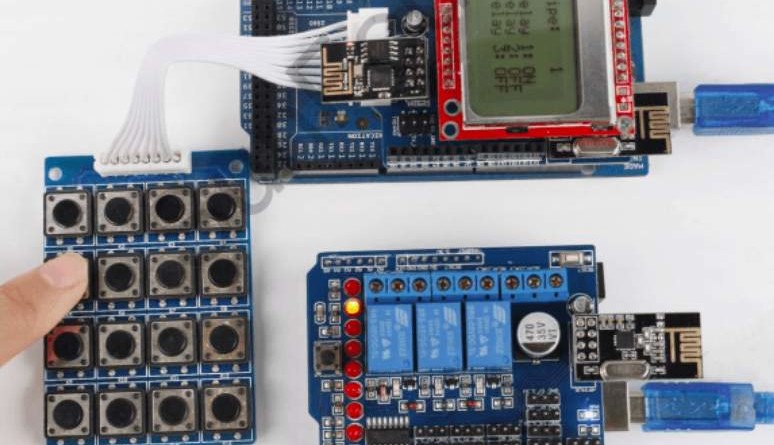
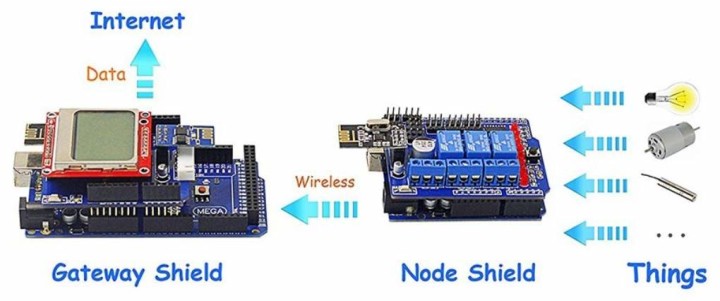
The kit consists of two boxes, one containing a Gateway Shield and the other a Node Shield. The latter comprises an I/O shield and a small NRF24L01 wireless module. The gateway shield has an on-board NRF24L01 module and a (mobile phone) LCD; an 4×4 keypad with cable and an ESP-01 Wi-Fi module are separate.
The Node Shield
This is an Arduino add-on board containing three relays, eight LEDs and a pushbutton. Also a bunch of 3-way pin headers are available for connecting sensors and other things: three analogue inputs (A0, A1 & A2, that can, of course, also be used as digital I/O) and two purely digital I/O ports (D6 & D7). These five ports each have two 3-way headers, one with +5V and the other with +3.3V. This is how the Sunfounder IoT Shield kit is supposed to be used.
The designer of the Node Shield has left no stones unturned to get the most out of the Arduino extension connectors. The LEDs are controlled by means of a 74HC595 shift register, which in turn is connected to ports A3-A5. The pushbutton is connected to D2. With D0 & D1 as serial port, this leaves ports D8-D13 for communicating with the NRF24L01 module.



Discussion (0 comments)