


Nunchuk USB Interface: Repurpose a Video Game Controller
Materials
Extra info / Update
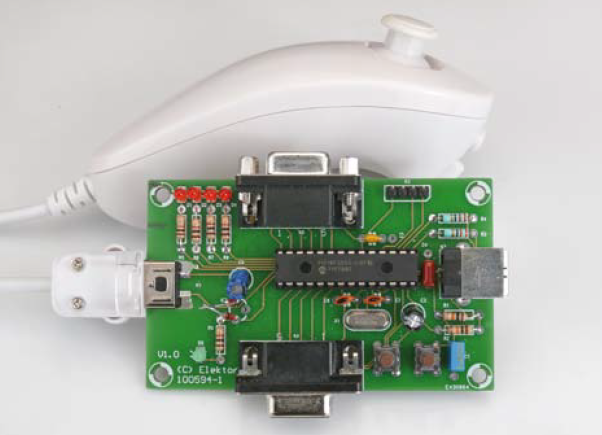
Nunchuk interface characteristics
• controller connected directly to the main PCB
• I²C protocol
• allows reading of the digital data from accelerometer (10 bits), analogue joystick (8 bits), and buttons (active Low)
• USB connector for interface with PC
• PIC programming with a bootloader and PDFSUSB software
• application programming using Flowcode
• DB9 sockets compatible with E-blocks modules
• 4-pin expansion port for a future serial link
Gerber file
CAM/CAD data for the PCB referred to in this article is available as a Gerber file. Elektor Green and Gold members can exclusively download these files for free as part of their membership. Gerber files allow a PCB to be produced on an appropriate device available locally, or through an online PCB manufacturing service.
The use of our Gerber files is provided under a modified Creative Commons license. Creative Commons offers authors, scientists, educators and other creatives the freedom to handle their copyright in a more free way without losing their ownership.
Want to build a project?
Bring your design to life with the Elektor PCB Service, powered by Eurocircuits. Upload the project files and order professionally manufactured PCBs or assembled boards through a proven European production platform.
Supporting KiCad, Eagle, Gerber, and ODB++ formats, the service is suitable for everything from prototypes and validation builds to series production and volume manufacturing.
Made in Europe. Fast. Reliable. Professional.
Bill of Materials
R1,R2 = 10kOhm
R3,R4 = 22Ohm
R5–R9 = 1kOhm
Capacitors
C1 = 470nF
C2 = 10µF 16V radial
C3 = 100nF
C4 = 220nF
C5 = 2.2µF 16V radial
C6,C7 = 22pF
Semiconductors
D1–D5 = LED, 3mm, low current
IC1 = PIC18F2550-I/P, DIP, 28-pin, programmed, Elektor # 100594-41
IC2 = LP2950ACZ-3.3
Miscellaneous
S1, S2 = pushbutton
K2 = USB-B connector, PCB mount
K3 = 4-pin pinheader
K4, K5 = 9-way sub-D socket, right-angled pins, PCB mount
X1 = 20MHz quartz crystal
PCB # 100594-1
Discussion (0 comments)