


High-speed ADC has 9 GHz bandwidth and $1,500 price tag
May 6, 2017
on
on
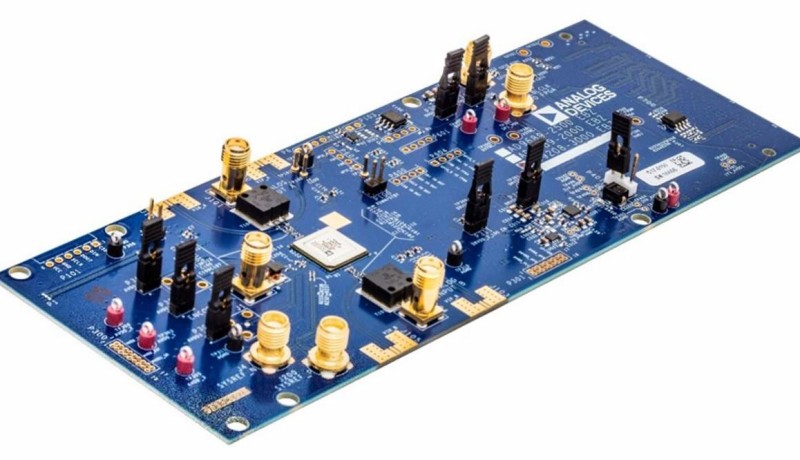
A new dual 14-bit A/D converter (ADC) designed to support communications applications capable of direct sampling wide bandwidth analog signals of up to 5 GHz has a −3 dB bandwidth of 9 GHz. The ADC cores feature a multistage, differential pipelined architecture with integrated output error correction logic. The device’s inputs support a variety of user-selectable input ranges while an integrated voltage reference simplifies the use of the part.
With sampling speeds up to 3 GSPS, the AD9208 from Analog Devices facilitates provides high oversampling, enabling direct RF sampling of wideband signals beyond 6 GHz, allowing more flexibility and the ability to eliminate mixer stages and simplifies system design with an internal clock divider and optional RF clock output. It also features a programmable Finite Impulse Response (FIR) filter block with up to 96 taps that can be configured for channel equalization and/or quadrature error correction.
The new ADC is complemented by the AD9172, a D/A Converter.
High speed comes at high costs: at 100+ quantities the chip retails for more than $1,500 a piece…
Illustration: Analog Devices
With sampling speeds up to 3 GSPS, the AD9208 from Analog Devices facilitates provides high oversampling, enabling direct RF sampling of wideband signals beyond 6 GHz, allowing more flexibility and the ability to eliminate mixer stages and simplifies system design with an internal clock divider and optional RF clock output. It also features a programmable Finite Impulse Response (FIR) filter block with up to 96 taps that can be configured for channel equalization and/or quadrature error correction.
The new ADC is complemented by the AD9172, a D/A Converter.
High speed comes at high costs: at 100+ quantities the chip retails for more than $1,500 a piece…
Illustration: Analog Devices
Read full article
Hide full article
Discussion (0 comments)